
Please read my newer Sony A6300 review before delving into the earlier Sony A6000, NEX-6, NEX-7, and DSLR camera comparisons in the article below.
For travel portability, DSLR cameras were antiquated in 2012-14 by Sony’s NEX-6, NEX-7, and successor A6000 series. The archive article below reviews these cameras (advantages, disadvantages, workarounds, lenses, autofocus/Manual/macro tips, firmware updates) and compares them to a Nikon D5000 DSLR and a Sony RX100 pocket camera. Legacy DSLR travel cameras and wildlife lenses of 2009-18 are covered at the bottom.
CONTENTS ■ Sony A6000 antiquated NEX ■ Sony 18-200mm classic travel lens ■ Travel zooms for Sony A6xxx & NEX ■ SEL vs SAL lenses ■ Prime non-zoom E-mount lenses ■ Sony A6000 beats Olympus, Sony RX10M1, and Panasonic FZ1000 ■ Mirrorless versus DSLR ■ Sony NEX-7/6 vs Nikon D5000 , advantages ■ NEX-7 manual focus ■ NEX negatives & workarounds ■ NEX vs D5000 Table ■ NEX firmware ■ Legacy DSLRs: wildlife lenses , “designed for digital” , use full-frame lenses on APS-C? , compare Sony, Nikon, Canon 2009-2012
In 2014, Sony A6000 antiquated its predecessor NEX series
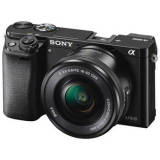
The Sony A6000 with 16-50mm Lens
Sony A6000 was the world’s best travel camera of 2014-15, capturing the sharpest images with the fastest autofocus in the smallest box. Using Continuous autofocus at an amazing 11 frames per second, A6000 tracks moving subjects right up to the edges of the frame, even recognizing and tracking faces. Compared to earlier Sony NEX-6 and NEX-7, the A6000 is superior except lacks a horizontal level indicator and has poorer resolution in the viewfinder (1.44 million dots vs 2.36 million; with slightly smaller magnification 0.70x versus 0.73x in terms of 35mm-equivalent; or 1.07x versus 1.09x in terms of APS-C). The following portable cameras hit the sweet spot for on-the-go travel photography in 2014-15:
- Sony Alpha A6000 camera (Amazon)
- Sony DSC-RX100 camera
Before the Sony A6000 was introduced, the sharpest images from the smallest box came from the mirrorless 24-MP Sony Alpha NEX-7 and 16-MP Sony NEX-6 cameras. Mirrorless interchangeable lens compact (ILC) cameras have since revolutionized travel photography beyond the legacy of DSLR designs. In 2012, I replaced my Nikon D5000 DSLR with a Sony Alpha NEX-7 camera mounted with the versatile Sony 18-200mm f3.5-6.3 OSS E-mount lens — together weighing just 33 ounces. In 2014, introduction of the Sony A6000 beat NEX cameras, and I purchased the A6300 in 2015
 A cowboy guides horses along dusty Park Butte Trail in Mount Baker Wilderness, Washington. Capture great spontaneous shots with Sony E-mount 18-200mm f3.5-6.3 OSS lens. Good travel photography demands an 11x zoom like this for rapidly framing from wide angle to telephoto within seconds. (Photo zoomed to 140mm telephoto, 1/125th sec, at f/8, on Sony Alpha NEX-7 camera.)
Mount the 18-200mm lens on Sony Alpha A6000 which has very fast Hybrid Autofocus (beating NEX-6 and -7). Sony says A6000 autofocus (as fast as 0.06 seconds) is the world’s fastest on a mirrorless camera with an APS-C image sensor as of 2014.
The great Sony 18-200 travel lens
Sony 18-200mm f/3.5-6.3 OSS e-mount SEL18200 silver lens
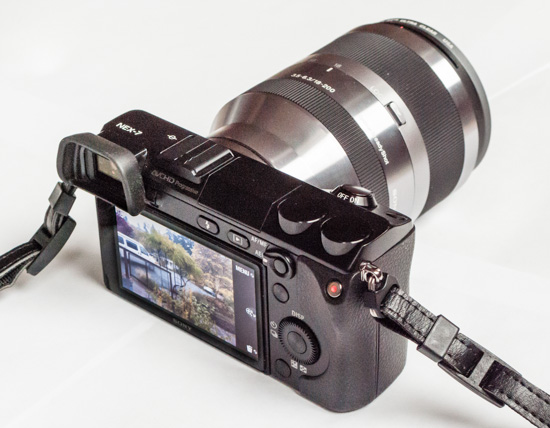
Add two essential scratch-resistant, multi-coated filters to this SEL-18200 lens:
- Tiffen 67mm Digital HT Ultra Clear filter
- Tiffen 67mm Digital HT Circular Polarizer filter
Advantages of Sony 18-200mm OSS lens:
- Sony SEL-18200 lens weighs only 18.5 oz for an 11x zoom (27-300mm equivalent focal length, in terms of 1.5x crop factor for APS-C).
- Sony SEL-18200 lens includes Optical SteadyShot (OSS) – image stabilization to steady handheld shots by 2-4 stops slower shutter speed, important for on-the-go travel photography.
- At 200mm, OSS stabilizes hand-held shots more sharply as slow as 1/60th of a second shutter speed (maybe not as good as latest Nikon VR II or Canon IS by up to one stop of shutter speed).
- At 18mm, OSS stabilizes to about 1/15th second. (1/8th second is usually blurry, needing tripod.)
- Surprisingly, when mounted on a 16mp NEX-5 or NEX-6, Sony’s 18-200mm OSS lens can be sharper than a prime Sony 24mm f/1.8 E-mount Carl Zeiss Sonnar (8 oz, SEL-24F18Z) lens
- For brighter shooting f/1.8-2.8, see “Prime lenses for Sony NEX” further above.
- Simplify travel gear by carrying a single 18-200mm, 11x zoom lens. I prefer carrying a 33-ounce NEX-7 system with one lens instead of my previous 71-ounce Nikon two-lens system:
- Sony SEL-18200 equals or beats the quality of the popular Nikon DX 18-200mm VR II lens
- From 18-200mm on a Sony NEX-7, image quality is up to 40% better than my previous Nikon D5000 camera with a Nikon 18-200mm VR II lens.
- Delightfully, cropping shots from 24mp Sony NEX-7 using this Sony 18-200mm lens beats the resolution of my 26-oz Nikon 70-300mm F4.5-5.6G ED-IF AF-S VR Zoom lens
- Upgrading to a Nikon D3200 camera
- Sony SEL-18200 equals or beats the quality of the popular Nikon DX 18-200mm VR II lens
- Sony’s “LE” version (black-colored SEL-18200LE) of its 18-200mm lens is okay for a NEX-6 but not for NEX-7.
- The LE version saves 2 ounces and may be more appropriate for the lower resolution (16 MP) of NEX-6.
- The slightly bigger Sony 18-200mm f/3.5-6.3 OSS e-mount SEL18200 silver lens
with 67mm filter size is clearly sharper than the newer, smaller 16-oz Sony 18-200mm OSS black SEL18200LE lens
with 62mm filter size (new 2012, colored black).
- Due to larger sensor (APS-C), mounting SEL-18200 on NEX-6 or NEX-7 beats using a Panasonic HD 14-140mm lens
For sharpest results from this 18-200mm, shoot in the sweet spot between f/5.6 to f/8 (easily set in Aperture Priority mode). Wider openings will soften the image and smaller openings such as f/16 cause unwanted diffraction. A Blur Index Test for SEL-18200 at Imaging-resource.com shows:
- 18mm is sharpest at f/3.5-5.6
- 35mm is sharpest at f/5.6
- 50mm is sharpest at f/8
- 70mm is sharpest at f/5.6-f/8
- 100mm is sharpest at f/8-f/11
- 200mm is sharpest at f/6.3-f/8.
- While f/16 can increase depth of field, f/16 resolves detail blurrier than most brighter apertures (wider openings, as above) on this 18-200mm lens (and most SLR lenses in general), due to diffraction through a smaller opening.
- Easily correct its noticeable chromatic aberration and distortion automatically in Adobe Lightroom 4: Develop > New Preset > Lens Corrections (check box), and apply to every image upon Import. See how this works on a single image by using Develop > Lens Corrections > Profile > Enable Profile Corrections.
Disadvantages of Sony 18-200mm OSS lens:
- Flash shadow: Sony 18-200mm lens (SEL18200) casts a shadow from 18 to 50mm using NEX-7 pop-up flash, fixed by mounting taller Sony HVL-F20AM flash
- Compromised optics: Perfectionists say the amazingly sharp 24mp sensor on a Sony NEX-7 demands lenses with optics better than an 18-200mm (11x) lens. See above: “Best lenses for Sony Alpha NEX cameras.”
- In its defense, Sony 18-200mm (SEL-18200) lens quality equals or exceeds that of competitors’ 18-200mm or ≥11x lenses.
- In zoom lenses with ranges smaller than 11x, most camera brands (Nikon, Canon, etc) offer better optical quality in various larger, heavier, or brighter lenses (“faster” f/2.8 maximum aperture). But a lens with zoom range less than 11x lacks flexibility of composition and requires frequent swapping with other lenses, thereby interfering with creative momentum and hindering travel convenience.
- Poor close focus: SEL-18200 lens can focus as close as 12 inches from the tip of the lens for 1:3.7 reproduction onto the sensor, but I capture sharper macro with deeper depth of field using a high-quality compact camera such as Sony RX100 camera

White Avalanche Lilies bloom along Spray Park Trail, in Mount Rainier National Park, Washington. In light bright enough to shoot at ISO 100 to 400, when zoomed to their widest angle of view, small-sensor cameras can focus closer while capturing much deeper depth of field than normal lenses on larger-sensor cameras. Focus stacking: To further increase depth of field, two overlapping photos were manually stitched into a composite, using Layers in Adobe Photoshop. In two separate shots, I focused on the flower at 5 cm (Macro mode) and on Mount Rainier at infinity, using a pocket-sized Canon PowerShot S95 camera lens set to 6mm (widest angle).
Travel zoom lenses for Sony Alpha A6300, A6000 series, A5100, and NEX cameras
- For remarkable portability, instead of the Sony E-mount 18-55mm lens
- Sony 16-50mm f/3.5-5.6 OSS Alpha E-mount Retractable Zoom Lens (SELP1650)
- Sony 16-50mm f/3.5-5.6 OSS Alpha E-mount Retractable Zoom Lens (SELP1650)
- Sony E-mount 18-200mm f/3.5-6.3 OSS silver (SEL-18200) lens
- This 18-200mm “all-in-one” lens captures sufficiently-high quality for my professional print publications, such that no other lens on this page need be carried.
- See “Advantages/Disadvantages of Sony 18-200mm OSS lens” sections further below.
- The Sony 18-200mm silver (SEL-18200) lens
- Tip: Blur Index Test A (2011) shows SEL-18200 is sharpest around f/5.6 to f/8 through its 11x range.
- Other lens choices below depend upon your budget and willingness to swap lenses:
- Sony 10-18mm f/4 OSS Alpha E-mount wide-angle zoom lens
- Sony FE 24-240mm f/3.5-6.3 OSS E-mount lens
- Sony E-mount PZ 18-105mm F4 G OSS
- Sony Vario-Tessar T* E-mount 16-70mm F4 ZA OSS lens
- Sony E-mount 55-210mm (SEL55210) lens
- Sony E-mount 70-200mm F4 G OSS lens
In 2016, Sigma’s lens line-up became available for Sony E-Mount bodies by using a Sigma Mount Converter MC-11 (2016, ~3 oz, $250, compatible with Sony A7 FE-mount series, A6300, A6000, and NEX) giving full stabilization and autofocus for Sigma’s Canon-mount and Sigma-mount lenses. Here’s a super telephoto option:
- $1750: 83 oz for 225-900mm equivalent lens on A6000: Sigma 150-600mm f/5-6.3 DG OS HSM Contemporary lens for Canon EF
Note that Sony A-mount 70-400mm F4-5.6 G SSM II lens
SEL vs SAL Sony lenses
For NEX, I recommend Sony “SEL” E-mount lenses, but not necessarily lenses coded SAL. Sony SAL lenses are designed for full-frame (and APS-C) Alpha DSLR cameras, requiring a hefty 7-ounce A-mount adapter (Sony LA-EA2 Adaptor
NEX-6/NEX-7 cameras don’t need an adapter to support full-frame E-mount “FE Series” SEL lenses (announced October 2013 along with Sony A7 and A7R full frame E-mount cameras). The pricier FE Series glass diameter transmits an image circle large enough to cover a full frame sensor, meaning that the (smaller) APS-C sensor in NEX cameras can take advantage of the sharp center sweet-spot with little vignetting.
Prime (non-zoom) E-mount lenses for Sony A6000 and NEX-7
If you don’t mind swapping lenses or spending more for the sharpest possible images, a bright prime lens takes full advantage of a 24mp A6000 or NEX-7 (but not so much for a 16mp NEX-6 or NEX-5). Prime lenses (having fixed-focal-length and bright maximum aperture) are a bit sharper than kit zooms sold with a camera. Below are four good prime lenses for a NEX-7:
- Sony 50mm f/1.8 OSS E-mount prime lens
- has Optical SteadyShot (OSS) for sharper hand-held photos without a tripod
- offers good value for the money (about $300)
- has pleasing bokeh for portraits at f/1.8 to f/2.8 (but its angle-of-view is too narrow to be an all-purpose “standard” lens)
- is sharpest from about f/4 to f/8 (on Blur Index Test B for SEL50F18 on a NEX-5).
- is up to 3 stops brighter than Sony’s 18-200mm lens (SEL-18200), from f/4.5 to f/1.8
- Caveat: If sharpness is your only goal, the Sony 50mm lens only beats SEL-18200 at f/5.6 to f/8 when tested on a NEX-5 (which may also be true for NEX-6). However, SEL-50F18 may beat SEL-18200 at a brighter range of F stops on a NEX-7 (see dxomark.com). Test results on a NEX-5: compared to SEL-18200 Blur Index Test A (2011) zoomed to 50mm (where brightest aperture is f/5), a prime Sony 50mm lens (Blur Index Test B for SEL50F18) has slightly sharper corners at f/5.6 to f/8. But the Blur Index for SEL-50F18 from f/1.8 to f/2 resembles SEL-18200 at f/16, its f/2.8 is as sharp as SEL-18200 at f/11, and its f/4 is as sharp as SEL-18200 at f/8.
- Sony 35mm f/1.8 OSS E-mount prime lens
- has Optical SteadyShot (OSS) for sharper hand-held photos (without a tripod), as slow as a quarter of a second, an improvement of over 3 stops slower shutter speed!
- serves well as a high-quality standard lens (about $450).
- is sharpest at f/5 at infinity and f/4 at two feet.
- Sony 24mm f/1.8 E-mount prime Carl Zeiss Sonnar lens
- may be sharpest of the four, but costs several times the others’ price (about $1100).
- Blur Index Test C shows that SEL-24F18Z is sharpest around f/2.8 to f/5.6.
- **When tested on a NEX-5, compared to SEL-18200 Blur Index Test A (2011) zoomed to about 24mm (where its brightest aperture is f/4), a Sony 24mm lens (SEL-24F18Z) is slightly sharper at the corners at f/4, blurrier from f/8 to f/22, and impressively sharp at f/2.8 (like SEL-18200 at f/5.6), but its f/1.8, f/2, and f/11 are blurrier than SEL-18200 at f/11. (You must average results at 18 and 35mm zoom settings on SEL-18200 Test A to interpolate 24mm for comparison to Sony Zeiss 24mm lens.)
- Sigma 30mm f/2.8 DN prime lens for E-mount
- is a great value standard lens (about $200), excellent for landscapes, but not as sharp or bright as Sony SEL-24F18Z.
**Note: Real world lens use often makes lab testing moot. In Blur Index Tests A, B, and C (above) done on a 16mp NEX-5 in 2011, the 50mm and 24mm Sony prime lenses don’t have a striking advantage over using the SEL-18200 lens; but later tests at dxomark.com (2013) indicate clear advantages of using these prime lenses on a 24mp NEX-7. The above Blur Index Tests A, B, C measure sharpness at the optimal focus plane, found by focus bracketing on a NEX-5.
Today’s constantly improving quality and diversity of cameras give us many great tools for the job. Portrait photographers often want lenses designed for attractive bokeh (the artistic character of out-of-focus areas) at bright apertures such as f/2.8 and f/1.8. But optimal sharpness for a lens on APS-C and full frame cameras is usually a few stops down from brightest aperture, as shown in the above Tests A, B, C. Landscape photographers like me often say “f/8 is great” as we care about both highest resolution of detail and depth of field. Depth of field increases at higher F numbers such as f/11 to f/16, but diffraction through progressively smaller openings limits sharpness (blurs the resolution of image detail).
Prime lenses tend to be sharper than zooms. But I find that a Sony 11x zoom (silver SEL-18200
Sony A6000 beats Olympus OM-D E-M5 and E-M10 systems
The best splash-proof, dust-proof, hardy midsize camera of 2014-2015 for travel (with Micro Four Thirds sensor) was the Olympus OM-D E-M5 Micro Four Thirds Digital Camera (Mark I)
- Compare cameras:
- Sony A6000 with 16-50mm lens
- Olympus OM-D E-M10 Camera
- Sony A6000 with 16-50mm lens
- Olympus OM-D E-M5 features: high res Electronic Viewfinder (EVF), tilting 610,000-dot OLED LCD, 5-axis sensor-shift image stabilization, best 16mp sensor. The external, clip-on weather-sealed flash unit fits easily in a pocket.
- Note that its more versatile travel lens with extended telephoto doesn’t have weather sealing:
- Panasonic Lumix G Vario HD 14-140mm f/4.0-5.8 ASPH./MEGA O.I.S. lens
- Olympus M.Zuiko Digital ED 14-150mm f/4.0-5.6 lens
- Olympus M.Zuiko Digital ED 14-150mm f/4.0-5.6 lens
- Most compact (1.1″) Premium “X” lens (without weather sealing): Panasonic Lumix G X Vario PZ 14-42mm F3.5-5.6 ASPH OIS lens
- Panasonic Lumix G Vario HD 14-140mm f/4.0-5.8 ASPH./MEGA O.I.S. lens
Sony A6000 beats Sony RX10 version I and Panasonic FZ1000
- Panasonic FZ1000 camera
- For the same weight but twice the price as FZ1000, you can upgrade to Sony A6000 with 18-200mm lens and APS-C sensor (having 3x bigger light-gathering area, but maybe not as sharp at long end of telephoto).
- The Panasonic FZ1000’s brightest “equivalent F-stop” (f/7.7 to f/11 equiv from 25-400mm equiv) is not as bright as Sony’s E-mount 18-200mm f/3.5-6.3 lens (f/5.25 to f/9.45 equiv from 27-300mm equiv). [Definition: “equivalent F-stop” is the F-number on a full-frame-sensor camera which has the same hole diameter as the brightest F-stop of the camera lens being compared, and lets you compare control over shallowest depth of field.]
- Sony Cyber-shot DSC-RX10 camera
Note that other midsize cameras with smaller sensors generally capture fuzzier images:
- Olympus Stylus 1s (2015, 14 oz with 28-300mm equiv f/2.8 lens) is the world’s smallest camera having an 11x zoom on a 1/1.7″ type sensor. Its great electronic viewfinder is same as Olympus OM-D E-M5. Good 410-shot CIPA battery life.
- The following cameras have a tiny 1/2.3-inch Type sensor which should beat cell phone quality, requires bright outdoor light, and is suitable for sharing images online or making small prints:
- Panasonic Lumix DMC-FZ300 (2015, 24.4 oz, 12 mp, bright f/2.8 lens throughout 25-600mm equivalent, 24x zoom range, with OIS/Optical Image Stabilization, HD Video with sound, and raw file support) introduces weather sealing to keep out dust and moisture. Save money on earlier, non-sealed FZ200 or FZ70.
- Nikon Coolpix P900 (2015, 32 oz, 16mp, 24–2000mm equivalent 83X zoom lens)
- Olympus SP-100 camera
Mirrorless Sony A6000 versus bulkier DSLR/mirror cameras
Until about 2014, DSLR cameras advantageously interchanged more lens choices and shot action (sports, birds) more reliably with little shutter lag when using their optical viewfinder. “DSLR” means Digital Single Lens Reflex, where a mirror lets the viewfinder see through the lens. During a shot, the mirror briefly flips up to expose a digital sensor. However, almost all DSLR cameras of 2014 and earlier have excruciatingly slow autofocus (2-4 seconds) in Live View on the LCD − except for Canon 70D
- Sony Alpha SLT-A65V camera body only (from Amazon.com) (2011, 22 oz body with SteadyShot INSIDE Stabilization, 24mp APS-C sensor), plus Zeiss Vario-Sonnar T* 16-80mm f/3.5-4.5 ZA DT lens
However, the newer Sony A6000 with 16-50mm lens
Sony NEX-7 and NEX-6 versus Nikon D5000
The Sony Alpha NEX-7 shaves 12 ounces and improves large-print quality by up to 40% compared to my former DSLR, a Nikon D5000 with Nikon 18-200mm VR II lens
Drop the bulky DSLR mirror box and upgrade to the instant feedback of an exquisite OLED electronic viewfinder (EVF) in a Sony Alpha NEX-6 or NEX-7 camera, to double the area visible through the viewfinder compared to most DSLR cameras! (1.09x linear magnification for NEX versus 0.78x for Nikon D5000 and others, measured in terms of APS-C.)
NEX-7 autofocus speed is fine for landscapes and moderate action (see horse rider photo). But the newer NEX-6 (now beat by A6000’s AF) accelerates autofocus with Hybrid AF (modifying a 16mp sensor with pixels devoted to phase detection), reducing shutter lag near DSLR speed.
For framing distant subjects or wildlife, digitally cropping the amazing 24 mp resolution of a Sony NEX-7 now saves me from carrying an extra telephoto lens when trekking. (When shot on a Nikon D5000, image resolution from 70 to 250mm on my former 26-ounce Nikon 70-300mm zoom lens
A pricey NEX-7 has a huge 24mp sensor (highest for APS-C Type cameras in 2012) for larger prints and sharper cropping to enlarge wildlife or birds. More economical was the 16-mp NEX-6, which thankfully added Hybrid AF (improved autofocus speed), a physical mode dial, Wi-Fi connectivity, and Quick Navi menu (all of which are sadly not found in NEX-7, which annoyingly requires 3 menu button presses to change modes P, A, S, M, SCN, etc). For travel, the LE version Sony 18-200mm OSS black SEL18200LE lens
On the go, protect your camera and 18-200mm lens in a Lowepro Toploader Zoom 50 AW Bag
Read my review/BUY page to compare with other camera brands such as Canon and Nikon — see how I decided that NEX was best!
Advantages of Sony NEX-7 and NEX-6
In 2013, photographers could pack a portable punch with the amazing Sony Alpha NEX-6 with 16-50mm Retractable Zoom lens (12 oz body + 4 oz lens, 24-75mm equiv), which saved $350 and 2 oz of body weight compared to a Sony NEX-7 camera
Both NEX-6 and NEX-7 cameras squeeze more impressive features than ever into a small box:
- A high-res OLED Electronic Viewfinder (2,359,000 pixels, superb 1.09x magnification) gives more accurate feedback on a final digital image than a non-digital optical viewfinder. The sharp EVF appears larger than the camera’s external screen and is easier to see in bright daylight.
- A tilting 921,600-dot LCD jump-starts your creative macro, movie, and candid shooting comfortably at arm’s length.
- NEX-7 beats rival APS-C sensor cameras for resolution, with 3400 resolvable lines per picture height (LPH) from raw files (versus 2800 LPH for NEX-6 and 2400 LPH for Nikon D5000, each measured on prime lenses).
- NEX-7 raw files (name extension .ARW) resolve more detail than a costlier full-frame-sensor Canon EOS 6D or 5D Mark III (2800 LPH) from ISO 100-1600. For capturing lower noise, full-frame cameras of 2012 require ISO settings above 1600 to clearly beat NEX-7 or -6.
- Upgrading to a resolution higher than NEX-7’s costs much more:
- Full-frame Sony Alpha A7R Mirrorless Digital Camera
- Full-frame Nikon D800 camera
- Full-frame Sony Alpha A7R Mirrorless Digital Camera
- NEX-6/NEX-7 capture excellent dynamic range (bright to dark) and the lowest noise at high ISO compared to APS-C rivals.
- Using ISO 6400 capturing dim action indoors, my NEX-7 shot publishable images for a spotlit theater production.
- TIP: When shooting at ISO ≥800, capture 1 stop less noise by using Anti Motion Blur (my favorite) or Hand-held Twilight mode. Both modes can automatically set ISO up to 6400, thereby working around Auto ISO being sadly restricted to ≤1600.
- Hand-held Twilight (a Scene mode under SCN) helps get sharper low-noise, low-light shots of static subjects without a tripod for ISO ≥800. Six frames are auto-shot continuously then stacked into a single JPEG image to lower noise levels (requiring 8 seconds processing time, delaying the next possible shot). Hand-held Twilight mode cannot create a raw file, but the resulting improvement in hand-held JPEG image quality couldn’t otherwise be captured.
- Anti Motion Blur (set directly on virtual mode dial) likewise makes a JPEG file but favors faster shutter speeds to freeze action or steady hand-held telephoto, at the cost of setting ISO higher (noisier) than Hand-held Twilight mode.
- Sweep Panorama mode instantly stitches exciting JPEG panorama images horizontally or vertically (although manually stitching panoramas from multiple raw files is reliably superior in Adobe Lightroom software
- Sony NEX ingeniously pops-up a small flash, which can be tilted up for bounce. For brighter reach and to avoid shadows from 18-200mm lens, mount Sony HVL-F20AM flash
Secret MENU one-time settings improve Manual Focus for NEX-7
- CAMERA > AF/MF Select > DMF (helpfully allows Direct Manual Focus with turn of focus ring after autofocus lock during half-press of the shutter release button)
- SETUP > AF/MF Control > Toggle (is better than “Hold” option to better grasp the camera steadily)
- SETUP > MF Assist > ON (enlarges MF view, optimally for 2 seconds)
- SETUP > MF Assist Time > 2 seconds
- SETUP > CUSTOM KEY SETTINGS > AF/MF Button > AF/MF Control (lets AF/MF Button enable MF mode / lens focus ring)
In dim or low-contrast lighting, if autofocus fails to lock (thereby preventing DMF), try MF mode, arranged as above. Point the AEL swivel-switch to AF/MF, then press AF/MF Button to invoke MF, then turn manual focus ring on lens. When set as Toggle, MF mode stays in effect even after pressing the shutter button, unless cancelled by pressing AF/MF Button again or any other button. (Note: Sony’s 18-200mm lens has no built-in MF switch and relies on the above body settings.)
To set up MF default and create an AF button (to disconnect half-press focusing by shutter release button), you can change two settings above:
- CAMERA > AF/MF Select > MF
- SETUP > AF/MF Control > Hold
- Now holding down the AF/MF Button locks autofocus (instead of half pressing the shutter button).
Why not NEX? Negatives with workarounds:
- Autofocus and Manual Focus:
- NEX-6 introduces Hybrid AF, with autofocus nearly twice as quick as NEX-7.
- Although its autofocus is generally fast, usually without much lag, a NEX isn’t as good for shooting fast action (like birds in flight) with tracking-autofocus (which I rarely use), where traditional DSLR cameras can focus faster than mirrorless ones.
- For better autofocus in dim light using a NEX-7, turn OFF the AF Illuminator in MENU>SETUP, or else focus will likely be taken from the background within a big green indicator box filling most of the frame. (The AF Illuminator lamp is blocked by the fat 18-200mm lens and reportedly works poorly with other lenses.)
- In low light conditions or at longer focal lengths, autofocus can stick (freeze), out-of-focus (also disabling DMF because focus fails to lock), requiring several seconds or minutes to recover. Fix by turning camera OFF then ON. The MF button (above) might help, but usually not. (Will NEX-6 hybrid autofocus fix this occasional problem?)
- Lens choices are few for Sony NEX E-mount, such as for telephoto:
- Workaround:
- For telephoto photography of small wildlife or birds at a distance, easily digitally crop a 24mp NEX-7, shot with the sharp, stabilized Sony 18-200mm f/3.5-6.3 OSS e-mount SEL18200 silver lens
(Optical SteadyShot) zoom lens, optimally shot from f/5.6 to f/8. See lens recommendations above.
- For telephoto photography of small wildlife or birds at a distance, easily digitally crop a 24mp NEX-7, shot with the sharp, stabilized Sony 18-200mm f/3.5-6.3 OSS e-mount SEL18200 silver lens
- Nikon VR II and latest Canon IS lenses may beat Sony’s OSS for stabilizing hand-held shots by up to one stop of slower shutter speed (but NEX low-noise at high ISO can make up the difference).
- Because they’re targeted for camera bodies with sensor-shift image stabilization, Sony A-mount (SAL) telephoto lenses lack optical stabilization (no OSS) and require a hefty A-mount adapter to work on a NEX camera.
- A sharp Sony A-mount 70-400mm F4-5.6 G SSM II lens
- Sony A-mount to NEX E-Mount lens adapters include:
- Sony LA-EA2
- LA-EA1 (with Manual focus only, NO AUTOFOCUS).
- Sony LA-EA2
- A sharp Sony A-mount 70-400mm F4-5.6 G SSM II lens
- For lightweight travel: Kenko 400mm fixed-f/8.0 Mirror Lens with T-mount Adapter for NEX
- Workaround:
- Important Playback tips:
- Auto Review responsiveness is now instant (fixed by NEX-7 firmware update v1.01). During Playback, the Center button nicely zooms to 100% pixel level to check sharpness and toggles back to the full image. When deleting a single image, don’t be alarmed by “Deleting Files” plural message — just the one image is deleted.
- Each time you record (a Still image, MP4 video, or AVCHD video), the Playback screen shows only that file type, hiding other image types, but yikes, where? Toggling between file types requires obscure key sequences:
- Press Down on the control wheel to display thumbnails of a given file type, press Left, press Center button, choose the type of file that you want to view, then finally press Center button again. Very annoying!
- Or, press MENU > Playback > ViewMode > Folder View (Still) / Folder View (MP4) / AVCHD View.
- Or, to Playback the thumbnails of the file type which were not last recorded, record a quick test file of the type you want then press Playback then Down (then delete the test shot).
- As with Nikon cameras, Sony NEX-7 / NEX-6 have poorer menu/button structure than user-friendlier Canon and Panasonic cameras, thereby requiring extra time to learn the oddly-buried menus.
- Battery life:
- Because an Electronic Viewfinder (EVF) consumes more power than an optical viewfinder, battery life for NEX-6/NEX-7 will be shorter than for a DSLR camera (see COMPARISON TABLE below).
- When trekking away from electrical outlets, buy extra Sony NP-FW50 Lithium-Ion Rechargeable Batteries (1080mAh)
- Huge files:
- 24-megapixel files from a Sony NEX-7 are so huge (full of luscious detail) that you’ll need to spend more money upgrading to the latest, most powerful computer with lots of RAM and 64-bit Operating System (not 32-bit), in order to optimize memory-handling in important programs such as Adobe Lightroom software
- 24-megapixel files from a Sony NEX-7 are so huge (full of luscious detail) that you’ll need to spend more money upgrading to the latest, most powerful computer with lots of RAM and 64-bit Operating System (not 32-bit), in order to optimize memory-handling in important programs such as Adobe Lightroom software
CAMERA COMPARISON TABLE: NEX-6, NEX-7, Nikon D5000
For travel portability with top image quality, Sony NEX-6 and NEX-7 cameras easily beat my former Nikon D5000 DSLR dating from just 3 years previous (green box is best):
| CAMERA FEATURES | Sony Alpha NEX-6 (2012) mirrorless camera + Sony 16-50mm E-mount Retractable Zoom Lens (SELP1650) | Sony Alpha NEX-7 camera (2011) mirrorless camera + Sony 18-200mm f/3.5-6.3 OSS e-mount SEL18200 silver lens (18.5 oz, 27-300mm equiv) |
Nikon D5000 (2009) DSLR camera + Nikkor 18-200mm VR II lens |
| Weight with battery + lens: | 16 oz = 287 g / 12 oz body + 4 oz lens |
33 oz = 14 oz body +19 oz lens |
43 oz = 23 oz body + 20 oz lens |
| Camera body size: | 120 x 67 x 43 mm (4.72 x 2.64 x 1.69″) | 120 x 67 x 43 mm (4.72 x 2.64 x 1.69″) | 127 x 104 x 80 mm (5 x 4.09 x 3.15″) |
| Megapixel (mp): | 16 mp, 4912 x 3264 | 24 mp, 6000 x 4000 | 12 mp, 4288 x 2848 |
| Sensor type: | APS-C, CMOS. Focal length multiplier 1.5x. | APS-C, CMOS. Focal length multiplier 1.5x. | APS-C, CMOS. Focal length multiplier 1.5x. |
| Autofocus (AF) type: | New, quicker Hybrid AF combines fast phase detection with contrast detection. Good AF in movies/video. | Fairly fast contrast-detection AF. Good AF in movies/video. | Fast phase-detection AF using viewfinder, but very slow 2-3 second AF in Live View on LCD. No AF in movies/video. |
| Drive speed frames per second (fps): | Up to 10 fps “Speed Priority Continuous” with focus fixed at first shot, or 3.7 fps “Continuous Shooting” with autofocus on each shot. | Up to 10 fps “Speed Priority Continuous” with focus fixed at first shot, or 3.7 fps “Continuous Shooting” with autofocus on each shot. | Up to 4 fps Continuous with autofocus on each shot. |
| Close focus distance: | 10 inches, 1:4.7 reproduction with 16-50mm lens. | 10 inches, 1:3.7 reproduction with 18-200mm lens, albeit rather fuzzy. Read Macro topic at bottom of article. | 20 inches, 1:4.5 reproduction with Nikon 18-200mm lens. |
| Battery life (CIPA): | 360 shots on one charge | 430 shots | 510 shots |
| Viewfinder: | 2,359,000 pixels electronic/EVF covers 100% with 1.09x magnification (0.73x equivalent in terms of full frame)! | 2,359,000 pixels electronic/EVF covers 100% with 1.09x magnification (0.73x equiv)! | optical pentamirror covers 95%; with 0.78x magnification (0.52x equivalent in terms of full frame), sadly just half the viewing area of NEX-7 or NEX-6! |
| LCD: | 3 inches. 921,000 pixels. Xtra Fine LCD with Tilt Up 90° and Down 45° | 3 inches. 921,000 pixels. Xtra Fine LCD with Tilt Up 90° and Down 45° | 2.7 inches. 230,000 pixels, fully articulated, but hard to use in Live View due to painfully slow autofocus speed, 2-3 seconds. |
| Movies/video: | MPEG-4, AVCHD, stereo microphone (mono speaker), good AF. 1920 x 1080 (60, 24 fps), 1440 x 1080 (30 fps), 640 x 480 (30 fps) | MPEG-4, AVCHD, stereo microphone (mono speaker), good AF. 1920 x 1080 (60, 24 fps), 1440 x 1080 (30 fps), 640 x 480 (30 fps) | Motion JPEG, mono sound recording, no autofocus in movies/video. 1280 x 720 (24 fps), 640 x 424 (24 fps), 320 x 216 (24 fps) |
| Built-in flash: | 6 m range with 16-50mm Retractable Zoom. (New NEX-6 hot shoe requires Sony ADP-MAA Multi-Interface Shoe Adapter to mount Sony HVL-F20AM flash which fixes built-in flash’s shadow of 18-200mm lens from 18 to 50.) |
6 m range (plus hot shoe for external flash: Sony HVL-F20AM flash fixes built-in flash’s shadow from 18 to 50mm on 18-200mm lens) | 17 m (at ISO 100) (plus hot shoe for external flash) |
Sony NEX firmware updates
Sony NEX-7 downloadable firmware update v1.01:
- Firmware 1.01 thankfully makes Auto Review instant and usable. Fixed problem: Auto Review was formerly unusable due to long delay/black screen before automatically displaying the shot image.
- Firmware 1.01 now lets a (buried) menu disable/enable the overly-prominent movie record button which is frequently pressed accidentally. A better fix is to glue a rubber washer/gasket over the movie button with hole in the middle to allow access while preventing bumping. (NEX-6 not only solves the problem better by relocating the movie button but also adds a more practical mode dial for changing P, A, S, M, SCN, etc.)
Unfortunately, NEX-7 doesn’t have the new Hybrid AF (for faster autofocus) found on NEX-6.
Your NEX-6 should have Sony E-mount lens firmware update v2 (dowloadable) to enable Hybrid AF when mounting these Sony lenses:
- Sony 11x zoom 18-200mm f/3.5-6.3 (SEL-18200) lens
- Sony Zeiss 24mm f/1.8 (SEL-24F18Z) prime
- Sony standard zoom 18-55mm f/3.5-5.6 (SEL-1855) lens
- Sony telephoto 55-210mm f/4.5-6.3 (SEL-55210) lens
Legacy DSLR cameras 2016-18
The following DSLR camera makes an economical travel system:
- Nikon D3500 (2018, 13 oz body, 24 MP APS-C sensor/DX format, CIPA battery life 1550 shots)
- or upgrade: Nikon D5600 (2016, 16.4 oz body, 24 MP) adds fully articulated (flip out) LCD touchscreen
To capture diverse travel subjects, mount its body with one of the following interchangeable lenses which offer a generous zoom range:
- Tamron 16-300mm f/3.5-6.3 Di II VC PZD MACRO lens for Nikon
- Tamron 18-400mm f/3.5-6.3 Di II VC HLD Lens for Nikon F Mount (2017, 25 oz) (also available for Canon EF-S Mount): 22x zoom range, with Vibration Compensation stabilization to reduce handheld shake by up to 2.5 stops. At wide angles, its image quality is similar to kit lenses (commonly included as a package), but is too soft beyond 50mm compared to the above Tamron 16-300mm.
- Nikon AF-P Nikkor 70-300mm F4.5-5.6E ED VR (2017, 24 oz) takes sharper, faster-focusing shots of birds, wildlife, and sports.
Read “BEST TELEPHOTO ZOOM LENS 300mm+” to seriously magnify wildlife, birds, and sports with optical image stabilization.
DSLR cameras can also mount interchangeable ultra-wide- angle lenses to broaden the perspective. (Alternatively, use the ultra wide camera commonly found in smartphones, or capture a panorama automatically or manually.)
Good close focus, macro enlargement prime lenses for DSLR cameras
- Tamron SP 90mm f/2.8 Di Macro 1:1 VC USD (Model F017, released in 2016): 5.5-inch working distance; enlarges subjects down to 1.4 inches wide (3.5 cm)
- Nikon AF-S Micro-Nikkor 60mm f/2.8G ED Macro Autofocus lens
- Canon EF-S 60mm f/2.8 Macro USM lens for APS-C sensors
- Compared to the above 60mm lenses, longer macro lenses such as 100mm and 105mm give you a few more inches of comfortable working distance from the front of the lens (to avoid startling insects) and can have a different bokeh (character of out-of-focus areas), but at the cost of larger size, weight, and expense.
But instead of carrying one of the above prime macro lenses for a DSLR camera, consider upgrading to an A7CR (2023) with 8x Tamron lens. Good alternatives for close-focus are a smartphone or pocketable camera such as Panasonic ZS100 (read my review).
Legacy wildlife lenses made 2009-2018 for DSLR cameras
Because some photographers prefer optical viewfinders and/or economical DSLRs, below are discussed compatible wildlife lenses.
Get lenses “designed for digital” and “for APS-C size sensor cameras only”
Lighten your load with lenses designed for smaller lens formats DX, EF-S, DC, Di II, or Di III-A. Look for lenses marked “Designed for digital” and “For APS-C size sensor cameras only.” Newer lens designs reduce vignetting and cut weight and bulk while preserving image quality.
- Nikon/Nikkor DX format lenses for APS-C only (with “VR, Vibration Reduction” desired)
- Nikon DX 18-300mm f/3.5-5.6G ED VR lens
- Nikon AF-S DX 18-200mm f/3.5-5.6G ED VR II Zoom Lens (20 oz, new in 2009; earlier 2006 model used VR I): its size and weight are well optimized for Nikon cameras with DX sensors (APS-C size, as in Nikon D3300, D3200, D3100, D5100, D60, & D40X cameras). The DX lens design eliminates the extra glass which would have been required to cover a full 35mm size frame. Nikon DX format cameras have a “field of view crop factor” of 1.5, so this lens labeled 18-200mm can be thought of as a 27-300mm in 135 film terms.
- Nikon DX 18-300mm f/3.5-5.6G ED VR lens
- Canon EF-S lenses for APS-C only (with “IS, Image Stabilization” desired)
- Sigma DC lenses for APS-C only (with “OS, Optical Stabilization” desired)
- Tamron Di II lenses are Digitally Integrated for APS-C only (with “VC, Vibration Compensation” desired). Tamron Di III (full-frame coverage) and Di III-A (APS-C coverage) are for mirrorless cameras only.
- Because the above DX, EF-S, D, Di II, and Di III-A lenses are designed for cameras with APS-C size sensor only, they will cause vignetting (darkened corners) at the wide angle end of their zoom if used on “full frame sensor” DSLR cameras, such as on the expensive Nikon D3 (FX format), Nikon D700, Canon EOS 5D, or pricier Canon EOS 1D camera.
I enjoyed the following “lightweight” wildlife lens for Nikon DSLRs: Nikkor AF-S VR Zoom 70-300mm F4.5-5.6G ED-IF lens (26 oz, 105-450mm angle of view equivalent) — which resolves detail throughout its range 5 to 20% sharper (for bigger prints) than the versatile Nikon AF-S DX 18-200mm f/3.5-5.6G ED VR II Zoom (20 oz, 3 x 3.8″, 2009) travel lens. Alternatives:
- Tamron 16-300mm f/3.5-6.3 Di II VC PZD MACRO lens for Nikon
- Nikon DX 18-300mm f/3.5-5.6G ED VR lens
- Not recommended: Tamron 18-400mm f/3.5-6.3 Di II VC HLD Lens for Nikon F Mount (2017, 25 oz) (also available for Canon EF-S Mount): 22x zoom range, with Vibration Compensation stabilization to reduce handheld shake by up to 2.5 stops. At wide angles, its image quality is similar to kit lenses, but is too soft beyond 50-100mm compared to Tamron 16-300mm and the superior Sony RX10 IV and III.
- Not recommended: Tamron Di II VC AF 18-270mm F/3.5-6.3 LD Aspherical (IF) MACRO (2008, 19.4 oz, 15x zoom, compact 3.8″ × 3.1″, Model B003 for Nikon F Mount, whose 1.5 crop factor makes a 27-405mm equivalent) —
I disliked this Tamron lens, returned it, and instead upgraded to Nikon AF-S DX 18-200mm f/3.5-5.6G ED VR II Zoom Lens which served well from 2009-2012. My earlier Nikon 18-200 “VR I” focused more reliably than this Tamron in low indoors light on a tripod and cropping the Nikon’s 200mm images beat Tamron’s optical 270mm. The Tamron autofocuses slower and lens creeps badly when pointed up or down. Also avoid the following older version which lacks VC stabilization: Tamron Di-II AF 18-250mm F/3.5-6.3 LD Aspherical (IF) Macro. 430g (15.2oz). More notes for Tamron 18-270mm: minimum focus distance 19.3 inches throughout. Magnification ratio 1:3.5 at 270mm (74 x 49 mm coverage). Tamron claimed image sharpness to be similar to competitors (18-200mm Canon IS, Nikon VR, Sigma OS lenses) at same light weight, while zooming more, 15x versus 11x (but I found Nikon 18-200mm to be superior). Canon 18-200mm IS stabilizes images best of the bunch. Canon’s crop factor 1.6 makes 18-270mm equivalent to 29-432mm.
For wildlife photography, Canon Rebel cameras can use the Tamron 18-400mm, 16-300mm, or a lightweight Canon EF-S 55-250mm f/4-5.6 IS.
Using full-frame conventional lens on APS-C
The pricier full-frame-sensor DSLR cameras (such as Nikon D600 camera
- Advantages of conventional size lenses: The small APS-C size sensor (measuring about 22 x 15 mm) uses just the central area of the conventional 35mm lens, or the “sweet spot”, where images are usually sharpest, with lowest distortion (by not using the outside edges). Also, older lenses may be cheaper, easier to obtain, or already owned in your kit. And if you upgrade from an APS-C camera to a full frame DSLR, the conventional lens may stay compatible.
- Disadvantages: Conventional size lenses are bigger and heavier (versus the newer Nikon DX, Canon EF-S, Sigma DC, and Tamron Di II lenses “for APS-C size sensor cameras only”), and most people won’t eke an advantage from conventional lenses versus the APS-C-only lenses. Conventional film camera lenses will tend to vignette images when captured on digital sensors, due to unoptimized angles of incidence. Film can accept light from glancing angles, but the detector buckets of digital sensors require parallel rays.
In the lens brand list below, Popular Photography magazine October 2008 rates the following excellent travel lenses as roughly equal in image quality: Nikon 70-300mm 4.5-5.6G VR (which I’ve enjoyed using); Canon 70-300mm DO IS USM; and Sigma 120-400mm 4.5-5.6DG APO OS HSM AF.
Canon full-frame (EF-mount) conventional lenses with IS (Image Stabilization) for wildlife & travel images:
- Canon EF 70-300mm f/4.5-5.6 DO IS USM. 3.2 x 3.9 in., 25.4 oz (82.4 x 99.9 mm, 720g), makes a great extension to the IS kit lens sold with the Canon EOS 450D / Rebel XSi
- Canon EF 100-400mm f/4.5-5.6L IS II USM lens
- 1998 version: Canon EF 100-400mm f/4.5-5.6 L IS USM Lens. 48.0 oz (1380g), 3.6 x 7.4″ (92 x 189mm), 77mm filter, 1.5 stops image stabilization, 6.5 feet closest focus, push-pull zoom (sucks dust)
- plus bigger professional lenses with wider maximum aperture
Nikon/Nikkor full frame (F Mount) conventional lenses with VR (highly desirable Vibration Reduction) for wildlife & travel photography, in order of increasing price:
- Nikkor AF-S VR Zoom 70-300mm F4.5-5.6G ED-IF lens (equivalent to 105-450mm angle of view in terms of 135 film). 26 ounces; 5.6″ length; 4.9 foot minimum focus. Compatible with full frame Nikon D3 DSLR. Lens size and price point attract sports and wildlife/birder photographers. Nikkor 70-300mm is sharper than Nikkor 18-200mm VR.
- Nikon 80-400mm f/4.5-5.6D ED Autofocus VR Zoom Nikkor Lens: (120-600mm equivalent angle of view when used on a Nikon DX mount/APS-C camera) 3.6 x 6.7 inches; 48.0 oz (1360 g). Ken Rockwell says “This lens is a miracle…to shoot still subjects with long exposures without needing a tripod…but for sports you may want the 70-300 AF-S VR.” One reader complained that this lens “does not have AF-S, so I found the focusing too slow for moving birds…and it didn’t bring birds in close enough”.
- Nikkor AF-S VR Zoom 200-400mm f/4G IF-ED lens: 4.9 x 14.4 inches; 115.5 oz (3275 g). One of my readers was “impressed with the speed of its AF and the quality of the pictures, but the lens is awfully large and heavy”. About $5500.
- Nikon 500mm f/4G ED AF-S Vibration Reduction (VR II) Nikkor Lens
- plus bigger professional lenses with wider maximum aperture
Sony Alpha DSLR full frame conventional lenses:
- Sony SteadyShot INSIDE Stabilization (the sensor-shift built into Sony Alpha DSLR camera bodies) is a half or full stop of shutter speed worse than Nikon or Canon lens-based image stabilization, but Sony lenses may cost less for similar quality.
- Sony A-mount 70-300mm f/4.5-5.6 SSM G (SAL-70300G) lens
- Older, cheaper version without SSM: Sony 75-300mm f/4.5-5.6 Compact Super Telephoto Zoom Lens for Sony Alpha
- Sony A-mount 70-400mm F4-5.6 G SSM II lens
I don’t recommend using Sony A-mount lenses (such as 70-300mm or -400mm) on E-mount A6xxx series bodies such as A6400, A6300, A6000. Designed for in-body stabilization for Sony Alpha DSLRs, A-mount lenses all lack OSS (thereby requiring more tripod use on E-mount bodies). A-mount lenses also require a hefty A-mount adapter on E-mount bodies:
- Sony LA-EA2 adaptor
- Sony LA-EA1 adapter (with Manual focus only, NO AUTOFOCUS). You’d be better off using E-mount lenses on Sony A6400, A6300, or A6000.
Tamron and Sigma make good value full-frame conventional zoom lenses suitable for shooting birds and wildlife plus a wide range of other subjects, fitting many different brand camera bodies:
- Tamron 28-300mm F/3.5-6.3 Di VC PZD Zoom Lens
- Older: Tamron AF 28-300mm F/3.5-6.3 XR Di VC (Vibration Compensation) LD Aspherical (IF) Macro lens (19.4 oz, 3.06 x 3.9 inches): Close focus to 16 inches. Low Dispersion (LD) and Aspherical glass elements.
- Tamron SP 150-600mm F/5-6.3 Di VC USD
- The 2008 Sigma 150-500mm F5-6.3 DG OS HSM is no sharper at 500mm than the Tamron is at 600mm.
- This Tamron 150-600mm matches image quality at half the price of Nikon AF-S Nikkor 80-400mm f/4.5-5.6G ED VR.
- The Tamron’s modern optics easily beat the 1999 Canon EF 100-400mm f/4.5-5.6L IS USM.
- Tamron AF 70-300mm F/4-5.6 Di LD Macro lens. 3.0 x 4.6 in. 435g (15.3 oz). Not image stabilized.
- Tamron SP AF200-500mm F/5-6.3 Di LD (IF) lens. 3.7 x 8.9 in. 1237g (43.6 oz). Not image stabilized.
The following full-frame conventional zoom lenses by Sigma are a good price-value, fitting several different brand camera bodies:
- Sigma 150-600mm f/5-6.3 DG OS HSM Contemporary Lens
- Sigma APO 150-500mm F5-6.3 DG OS HSM lens (2008, 67.4 oz, 3.7 in. x 9.9 in.) filter diameter 86mm.
- Sigma APO 120-400mm F4.5-5.6 DG OS HSM lens: (61.7 oz/1750g, 3.6 in. x 8 in)
- Sigma APO 80-400mm F4.5-5.6 EX DG OS lens: Optical Stabilization helps by about 2 stops or so. Does not have HSM and may be slow to focus. 1750g/61.9 oz, 3.7 x 7.6 in.
- Sigma APO 50-500mm F4-6.3 EX DG HSM lens: 1,840g/64.9 oz; 3.7 in. x 8.6 in. It has no optical stabilization; but good DSLR cameras can compensate by a few stops using high ISO settings.
- plus bigger professional lenses with wider maximum aperture.
- Sigma glossary of terms: DG = Sigma’s conventional full-size lens. In the future, look for newer, smaller 300mm and longer Sigma “DC” lenses for APS-C only. OS = Optical Stabilization, very desireable. HSM = Hyper Sonic Motor for quiet and high-speed AF (Auto Focus), very desirable.
Tokina full-frame conventional lens for wildlife:
- Tokina 80-400mm f4.5-5.6 ATX 840 AF D: Angle of view 29° 50’ to 6°13’ on APS-C camera; Minimum focus distance 2.5m (8.2 ft.); dimensions 3.1 in. (79mm) X 136.5 mm (5.4in.); 1020 g (35.9 oz); introduced June 2006, for Canon EOS and Nikon D. Unfortunately no image stabilization.
Historical snapshot: compare Nikon, Canon, Sony 2009-2014
Nikon D3300 released in 2014 offered more for your money (at a lighter travel weight) than Canon EOS Rebel cameras of 2014 and earlier. Also, the earlier Nikon D3200 beat Canon Rebel DSLR cameras of 2012.
A good DSLR system was the Sony Alpha SLT-A65V camera (2012, later discontinued, 22 oz body with SteadyShot INSIDE Stabilization) with handy travel lens Zeiss Vario-Sonnar T* 16-80mm f/3.5-4.5 ZA DT lens for Sony Alpha
Comparable Nikon D60 and Canon Rebel cameras of 2009 gained back Sony’s handheld IBIS (in-body image stabilization) advantage through lower noise at higher ISO settings, so using a Nikon VR or Canon IS lens beat Sony’s handheld low light performance; but this rebalanced in future models.
Cropping a newer 24-megapixel camera beat a better lens mounted on older 12 MP camera!
In 2012, cropping my 24-megapixel Sony NEX-7 with all-in-one 18-200mm lens handily beat the real resolution formerly obtained from 70 to 250mm on Nikon’s good 70-300mm F4.5-5.6G VR lens (Amazon) used on my 12 MP D5000 DSLR camera. But upgrading to a 24 MP Nikon D3200 camera
Hoping to expand my NEX-7 by adding a Sony Zeiss 24mm, but I’m torn between this and the heavy 18-200mm which you praise so much, as my 55-210mm is really not very sharp and I could do with a good longer lens. (I guess both would be ideal with a second body to avoid switching lenses and also serve as a backup in emergencies. Budget question.) I have a Sigma 30mm (very good) and Sigma 16mm (less good), but would like a faster lens, i.e. the Zeiss. Will you be going with the new Sony A7? I was waiting for the A7, but the news that all new lenses would be needed made up my decision not to go that way yet. I have Sigma 16mm + 30mm, the Sony Kit [lens 18-55mm F3.5-5.6] and 55-210. Both of the latter are so so as far as quality. I would like a fast short lens and have been saving for the Zeiss 24mm. Unfortunately there are no decent longer prime lenses. I tested two 90mm Zeiss Sonnar (Contax) lenses. One was sharp, the other was not and both got stuck on the adapter. I just wished for a good autofocus lens (with manual override when time allows) around 90mm or above, not too slow and also not too heavy. I rarely do wildlife, but some landscapes need a tele. Many thanks… Your original report incidentally was decisive for my purchase of the NEX 7 a year ago.
— The new Sony A7 and A7R full frame cameras are intriguing, but require new, heavy, full-frame lenses, with restricted zoom ranges. A7/A7R won’t work well with Sony 18-200mm lens (which would vignette and crop the image down to APS-C size, removing the full frame advantage).
— The new full frame FE Series E-Mount 70-200mm F4 Sony G OSS lens (30 ounces, SEL70200G) will have very good glass for super sharp telephoto — a NEX-7 will use just the center, sharpest part (at the cost of extra weight and expense compared to an APS-C-only lens).
— For a NEX-7 lens 3.5-oz lighter than Sony 18-200mm, consider the 6x zoom Sony E PZ 18-105mm F4 G OSS (SELP18105G, for E-mount NEX APS-C-only) 15 oz.
— Prime lenses are a good idea on a 24mp NEX-7 if you intend to make very big prints: 2013 tests on a 24mp NEX-7 at dxomark.com show that a Sony 24mm f/1.8 E-mount Carl Zeiss Sonnar lens (SEL-24F18Z) is significantly sharper than a 18-200mm lens set at f/4 at 24mm. But the difference is minor on a 16mp NEX-6 or NEX-5 (in 2011 tests by SLRgear.com).
— Your Sony 55-210mm is cheaper and probably sharper than Sony 18-200mm: Reviewer Kurt Munger says “If you have a travel zoom, like Tamron NEX 18-200mm or Sony NEX 18-200mm, and find yourself using it mostly at the long end, the Sony 55-210mm would be a much better choice if sharpness is your major concern.”
— For bird/wildlife photos, a 27-oz Sony 70-300mm (SAL-70300G) lens plus 7-oz Sony LA-EA2 A-mount adapter (with fast phase-detection autofocus built-in) would be much sharper than the 18-200mm (SEL-18200) lens, but sadly Sony 70-300mm lacks OSS (as SAL lenses are designed for Alpha bodies with Inside Stabilization).
— I find Sony 18-200mm to be surprisingly good from 18 to 70mm, then not too bad through 200mm, sufficient for my publications. I like OSS to hand-hold wide angle shots at 1/15 second to blur streams while keeping stationary subjects sharp, which would be harder to keep steady (without tripod) on Zeiss 24mm which sadly lacks OSS. In my recent 1-month Dolomites trip with my wife, our luggage was much lighter without carrying a tripod. For lightweight travel, a NEX-7 with 18-200mm lens (33 oz total) easily beats my former Nikon D5000 with Nikkor 18-200mm. For my publications, 11x zoom range flexibility for rapidly-changing travel subjects trumps absolute sharpness.
— A little perspective: my pocket-sized backup camera Sony RX100 (version I, 8.5 oz, 2012) captures great wide-angle macro and landscape quality better than a Nikon D40X DSLR from 2007!