The archaic inch-sizing of camera light sensors is clarified in the illustration and table below, showing relative sizes and millimeters. Legacy sizing labels such as 1/2.5″ Type harken back to antiquated 1950s-1980s Vidicon video camera tubes.
CONTENTS ■ Sensor sizes illustrated ■ Most-versatile camera ■ Ideal travel camera ■ Full-frame sensor ■ APS-C ■ Micro Four Thirds
■ 1″-Type sensor ■ Smartphone sensors ■ Comparometer ■ Sensor table ■ Lens quality ■ Raw file format ■ Tradeoffs large & small
For a given year of technological advance, a camera with physically bigger sensor area tends to capture better image quality by gathering more light, but at the cost of larger-diameter, bulkier lenses. Recent digital sensor advances have shrunk cameras and increased optical zoom ranges while preserving image quality. The top smartphone cameras can potentially make good 18-inch prints and share publishable pictures. Clearly, an evocative image can be created with any decent camera in the hands of a skilled or lucky photographer. Before buying a larger camera, upgrade your phone to a top model (like Pro or Ultra) made in the past year or two. The best camera is the one you’re willing to carry.
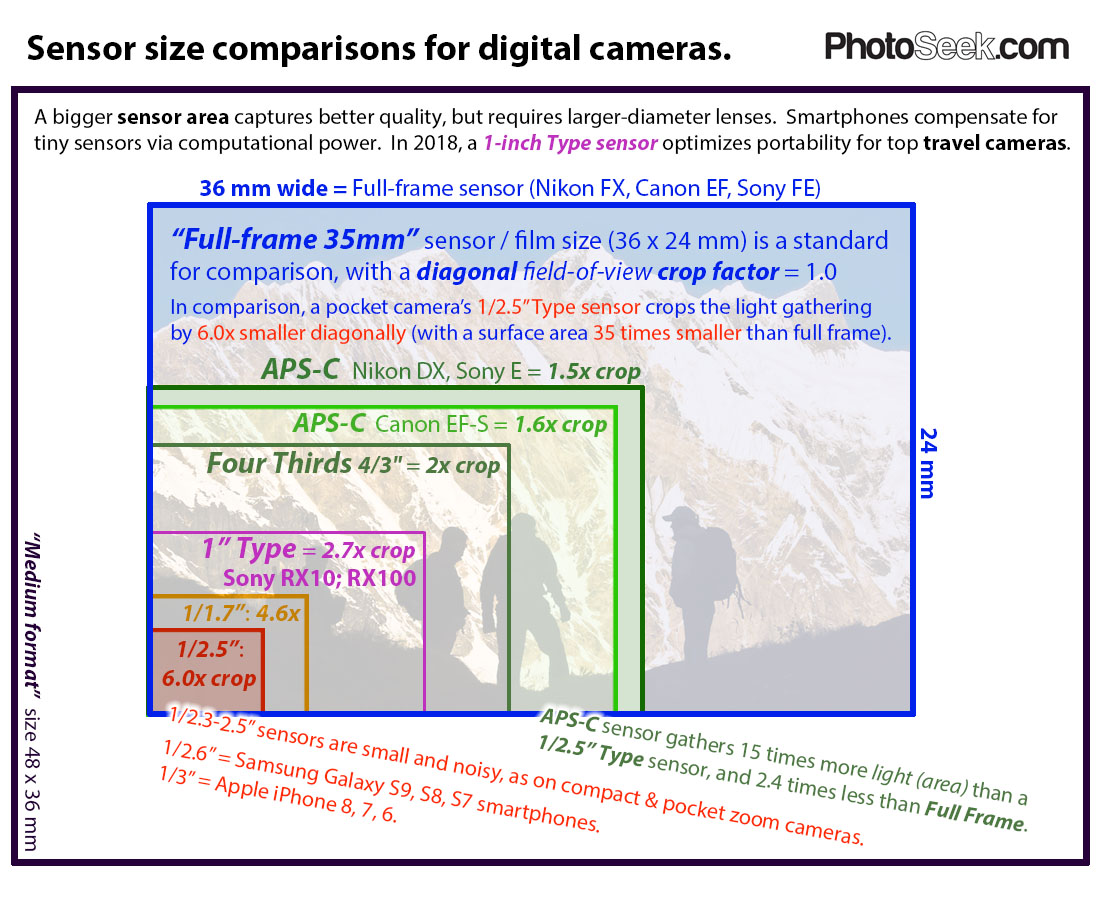
The above illustration compares digital camera sensor sizes: full frame 35mm (which is actually 36mm wide), APS-C, Micro Four Thirds, 1-inch-Type, 1/1.7″ and 1/2.5” Type. ■ For new digital cameras, a bigger sensor area captures better quality, but requires larger-diameter, bulkier lenses. ■ A “Full-frame 35mm” sensor (36 x 24 mm) is a standard for comparison, with a diagonal field-of-view crop factor of 1.0 — in comparison, a pocket camera’s 1/2.5” Type sensor crops the light gathering by 6.0 times smaller diagonally, with a surface area 35 times smaller than full frame… see sensor table below.
As an Amazon Associate, I earn from qualifying purchases through links on my PhotoSeek.com blog.
History: best sensor size for a versatile travel camera 2014-2025
Since 2023, the world’s best travel camera sports a full-frame-sensor with 60-megapixels (read Tom’s review):
- 38.5-ounce system: Sony A7CR camera (2023, 18.2 oz, prices at Amazon) mounted with its sharpest travel lens, the 8x optical zoom Tamron 25-200mm F2.8-5.6 Di III VXD G2 for Sony E-mount (2025, 20.3 oz).
- The A7CR’s generous 60-megapixel full-frame-sensor shot at 200mm on the Tamron lens is so sharp that it can be cropped to enlarge wildlife images. Tom’s field testing in July 2025 confirmed it to be sharper than his discontinued Sony RX10M4 from 28mm to 450mm equivalent — an impressive 16x equivalent zoom range. Further cropping this 200mm 60-MP A7CR system down to the sharpest central 6.7 MP (one ninth), or 600mm equivalent, resembles 10 MP shot on the Sony RX10M4 — still sufficient for publications.
In comparison, the following versatile 2024 camera using a Micro Four Thirds sensor cuts in half the system weight and cost, but captures only one-fourth as much light and one-third as many megapixels:
- 20.3-ounce, 20-megapixel system with 28-280mm equivalent lens: Panasonic LUMIX G100D Mirrorless Camera (2024, 11 oz) mounted with its best travel lens, the 10x zoom Panasonic LUMIX G Vario 14-140mm f/3.5-5.6 II ASPH. POWER O.I.S. Lens (2019, 9.3 oz). This system is heavier than a top smartphone but will be noticeably sharper. It’s an excellent lightweight alternative to the expensive full-frame system above.
Previously, from 2016–2022, the 1-inch-Type sensor size best optimized portability of sharp travel cameras, as in the discontinued Sony RX10M4 (read Tom’s review) and the 29-ounce 16x-zoom Panasonic FZ1000 version II (new in 2019, 29 oz, out of production 2025+). In comparison, travel cameras using physically-larger APS-C sensors required 11x to 19x optical zoom lenses which struggled to sharpen the edges of the frame.
With a sensor smaller than APS-C, the Micro Four Thirds systems lagged behind the competition from 2012-23 for sharp images from a generous zoom range in a compact package. Full-frame-sensor systems remained relatively bulky and heavy until 2023, when Sony’s compact 60-megapixel A7CR camera joined forces with Tamron’s sharp 8x and 7x zooms.
Advances during 2014–16 put the sweet spot for serious travel cameras somewhere between 1”-Type and APS-C size sensors.
Sensors smaller than “1-inch” Type can support super zoom ranges but worsen image quality, especially in dim light. Smartphones compensate for tiny cameras via computational power and instantly-shareable images, but can still fumble in dim light and telephoto reach.
Read Tom’s latest camera recommendations here.
Read Tom’s gear history for lightweight travel cameras 1978–now.
What makes an ideal travel camera?
The “best” travel camera is the one you want to carry everywhere. For many people, a smartphone is sufficient — so get one with the best telephoto reach as in the latest Pro or Ultra models.
Here on Photoseek.com, I recommend travel cameras which MINIMIZE bulk and weight while MAXIMIZING sensor dimensions, zoom range, lens diameter, battery life ( ≥ 350 shots), and ISO “sensitivity” (for lower noise in dim light). A sharp optical zoom lens should magnify the field of view by a factor of 8x to 25x to rapidly frame diverse subjects, without the bulk or annoyance of swapping lenses. Lenses should autofocus fast (with hybrid AF minimizing shutter lag ≤ 0.3 second), stabilize images to counteract camera shake, and focus closely (for good macro enlargement).
Travel cameras should flip out (articulate, hinge, or swivel) a high-resolution display screen to jump-start your creative macro, movie and candid shooting at arm’s length. OLED displays usually outshine LCD. Sunny-day reflections often obscure display-screen visibility − but to save bulk, most pocket cameras sadly lack a viewfinder. A camera with a brilliant electronic viewfinder (preferably EVF with ≥ 1 million dots) gives superior live feedback on the final digital image than a non-digital optical viewfinder.
Full-frame-sensor cameras
Full-frame-sensor cameras excel at night, indoor, high ISO 6400+, and very-large-print photography. Covering that large sensor area requires more glass, thereby restricting the optimally-lightweight zoom range. (To capture distant wildlife or birds while traveling, see BEST TELEPHOTO ZOOM LENS 300mm+.)
When an image is well-shot in bright outdoor light, the advantages of full-frame cameras may only be noticeable upon close inspection when printed bigger than 3 feet diagonally. Full-frame cameras tempt us with high megapixel counts such as 33 to 60 MP, but can be overkill for most practical publications, since a billboard only needs 3 to 10 megapixels at typical viewing distances.
However, the extra megapixels become important when cropping to increase the reach of sharp digital telephoto. In 2023, a new world’s best travel camera was born — by packing a 60-megapixel full-frame sensor within the compact Sony A7CR body, mounted with Tamron’s sharp 7x zoom lens (upgraded in 2025 to 8x zoom).
A tradeoff exists between absolute image quality, zoom range, system weight, bulk, and other features. The optimum is a personal choice.
APS-C size sensor
APS-C sensors cameras were antiquated from 2016–2025 by my Sony RX10M4 and RX10M3 travel cameras (discontinued in 2025) which use 1-inch-Type sensors.
A top APS-C-sensor camera (such as Sony A6xxx series) lets you interchange lenses and capture less noise in dim light than smaller sensors at ISO 3200+ sensitivity.
Earlier, bulkier DSLR-style cameras with APS-C sensor may attract traditionalists wanting a legacy optical viewfinder, improved night photography, and a bounty of lens choices, such as:
- Nikon D3500 (new in 2018) mounted with versatile Tamron 16-300mm f/3.5-6.3 Di II VC lens (Amazon) (new in 2014) made a good-value 32-ounce DSLR travel system.
- In 2012, I outgrew optical viewfinders. I prefer the digital live view of an Electronic Viewfinder (EVF), which closer resembles the final image, as featured in mirrorless digital cameras, such as the Sony A6xxx series and earlier Alpha NEX-7, when using APS-C sensors.
Micro Four Thirds Cameras
Panasonic and OM SYSTEM (formerly called Olympus) make excellent Micro Four Thirds sensor systems, which sadly lagged rival travel cameras from 2012 through 2023. Finally in 2024, Panasonic miniaturized a new paradigm for compact interchangeable lens cameras:
- 20.3-ounce, 20-megapixel system with 28-280mm equivalent lens: Panasonic LUMIX G100D Mirrorless Camera (2024, 11 oz) mounted with its best travel lens, the 10x zoom Panasonic LUMIX G Vario 14-140mm f/3.5-5.6 II ASPH. POWER O.I.S. Lens (2019, 9.3 oz).
I’ve oft admired the solid quality of recent Micro Four Thirds cameras such as Olympus (rebranded as OM System in 2022) who made my beloved OM-1N film camera back in the 1980s. But Olympus upgrades came too late for me, such as their belated sensor improvement from 16 to 20 megapixels (as in Olympus M1 Mark II & III in 2016 & 2020; and in M10 Mark IV in 2020). In comparison, the Sony A6xxx camera series is nearly as compact, yet collects more light onto a physically larger 24mp APS-C sensor. Pricing was also similar comparing APS-C vs 4/3 when shopping for slightly older versions or used gear. And for zoom ranges larger than 8x, the 1″-sensor Sony RX10M4 and RX10M3 cameras (discontinued in March 2025) beat all comers anywhere near their weight class (39 ounces), with a surprisingly sharp 25x zoom system.
The 16-megapixel sensor and performance of the early models of Olympus M1 (Mark I, introduced in 2013) and M10 (I-III) paled in comparison to the 24-megapixel sensor APS-C systems that I used from 2012-2016 (on Sony A6300 and predecessor NEX-7, using Sony 18-200mm lens, 11x). For example, look at the Panasonic GX80 (2016), a good Micro Four Thirds system with interchangeable lenses. For the GX80’s weight and expense class, the Sony A6400 or A6300 cameras provide more for the money — 45% larger light-gathering sensor (APS-C), generally better quality images (24 MP vs 16 MP), better viewfinder, excellent hybrid focus system, and longer battery life (400 versus 290 shots per charge) — all at a similar weight.
After test trials in 2016, I switched from APS-C to the 20MP 1-inch-Type sensor Sony RX10M3, which more than doubled my optical zoom to 25x, while equaling or improving overall image quality from edge-to-edge. Upgrading to Sony RX10M4 in 2018 strengthened the deal by speeding autofocus. This sharp 24-600mm f/2.4-4 zoom camera system weighing just 39 ounces was a game-changer for hiking and general travel photography through 2022. Caveat: although it’s one of the most versatile cameras ever invented, Sony RX10M4 isn’t optimized for night photography, wedding photography, or certain other specialties that don’t require a large zoom range.
To emulate the Sony RX10M4’s 25x zoom range with Micro 4/3 lenses is a heavier and pricier proposition, debatably without a commensurate gain in image quality. For example, consider the following high-quality 69+ ounce system with two lenses covering 24-800mm equivalent zoom range mounted on a Micro Four Thirds sensor:
- Panasonic Leica DG Vario-Elmar 100-400mm f/4-6.3 Power OIS lens (2016, 35 oz, 72mm filter size, 3.3 x 6.8″), mounted on Panasonic DMC-GX9 mirrorless camera (2018, 14 oz body, 20mp, 260 shots per battery charge CIPA), both weather-sealed.
- Add 20+ ounces for one or more zoom lenses to cover 24-200mm equivalent.
- That totals 69 ounces for an impressive 24-800mm equivalent system (14 oz body + 35 oz + 20 oz) using two lenses spanning a 33x zoom range. Although overly hefty for hiking, this system might attract a vehicle-based photographer who considers incremental image quality gains to be more important than the extra system cost, bulk, weight, or inconvenience of swapping lenses.
1″-Type sensor size optimizes pocketable travel cameras
In 2018, the best & brightest pocketable zoom camera was the Sony Cyber-shot DSC-RX100 VI (at Amazon) (11 oz, 8x zoom 24–200mm f/2.8-4.5) — my favorite backpacking camera. Upgrading to Sony RX100 VII (2019) focuses even faster and remains the world’s best pocketable travel camera as of 2026. Read my RX100M6 review.
- Cheaper alternative: Panasonic LUMIX ZS100 camera (Amazon) (2016, 11oz, 10x zoom, 25-250mm equivalent, 20 MP). The pocketable ZS100 (read my review) is not as sharp as the 3x-zoom Sony RX100 V, IV or III cameras, but captures close macro at more zoom settings and enormously extends optical telephoto reach 70-250mm, which clearly beats digitally cropping those 3x-zoom rivals.
Since the release of Panasonic ZS100 in 2016 and Sony RX100 VI in 2018, publishable image quality can now come from pocketsize cameras having versatile 10x or 8x zooms. Capturing 20 high-quality megapixels, both the Panasonic ZS100 and superior Sony RX100 version VI rival the daylight image quality of all of my camera systems used over 34 years until 2012 — beating my cameras up to 4 times heavier, up to 11x zoom range, up to 12 megapixels, shot at base ISO 100.
From 2018 to June 2025, Tom’s main camera was the versatile Sony RX10 version IV (39 oz, 25x zoom, 1″-Type sensor), which was discontinued in March 2025 — read my RX10 IV review.
Smartphone sensors
Most cheaper compact cameras have smaller but noisier sensors such as 1/2.3″ Type (6.17 x 4.56 mm) — tiny enough to miniaturize a superzoom lens, but poor for capturing dim light or for enlarging prints bigger than 12-18 inches.
Past smartphones have included even tinier camera sensors, such as 1/3.0″ Type (4.8 mm x 3.6 mm) in Apple iPhone versions 5S through 8.
Read a fascinating perspective on how far image quality has progressed from early DSLR to 2014 smartphone cameras. Similar smartphone leaps have continued through 2026.
Remarkably, top smartphone cameras have improved miniature sensors to the point where citizen journalists can capture newsworthy photos with image quality good enough for fast sharing and quick international publication. The latest Google Pixel, Samsung Galaxy, and Apple iPhones include great cameras, especially the top models.
The iPhone 15 Pro and Pro Max use a 48MP main camera sensor of 1/1.28″ Type, a significant upgrade from previous models, capturing better low-light performance and more detail.
Back in 2015, my Samsung Note5 smartphone (same camera as in S6 & S7, with 1/2.6″ sensor) captured sunny 16-megapixel images sufficient to make a sharp 18-inch print, virtually indistinguishable from that taken by a larger camera. Since then, the main camera in the Ultra models of Samsung Galaxy S23 and S24 boast a superior 200MP sensor of 1/1.3″-Type.
Smartphone tips:
For a given model year, the top phone cameras from Samsung and Google generally match Apple iPhone for image quality.
A 2x power tele on a smartphone resembles the field of view of a 50mm-equivalent lens; 3x resembles 75mm; 5x resembles 130mm; and 10x resembles 260mm equivalent. Tiny subjects can be enlarged biggest at close focus using the telephoto lens (like a macro lens), such as for conveniently copying color film slides. To better isolate subjects at a distance, update your model with a bigger telephoto camera, such as on the latest iPhone Pro Max or Pro models. Night Mode has also greatly improved in the latest premium models.
Samsung Ultra models of Galaxy S22 and S23 included a 10x optical zoom which works great, Tom can attest (beating his former 35mm-film cameras). Upgrading to the S24 Ultra’s 5x telephoto camera with 50MP sensor actually improves cropping and digital zoom up to 10x.
The iPhone 17 Pro and 17 Pro Max introduced an excellent 48-megapixel 4x optical telephoto which can produce an 8x tele 12MP image, which beats the previous iPhone 16’s 12MP 5x tele. The 17 Pro is a new paradigm where the smaller iPhone model has identical cameras to the larger 17 Pro Max.
How to compare cameras
Instead of wading through this article discussing sensors, you can save time by going directly to Tom’s CAMERAS article for his latest camera recommendations.
How can we judge image sharpness from different cameras?
- If possible, compare cameras shot side-by-side under a variety of field conditions. I like to “pixel-peep” a side-by-side comparison of two different cameras capturing the same subject under same lighting conditions. Be sure to mentally or digitally normalize any two given shots to compare their fine detail as if printed with equal overall image size. I like to confirm the quality of the new replacement camera before selling the older camera.
- Judge image quality and resolution at 100% pixel enlargement at the authoritative dpreview.com (owned by Amazon since 2007) and handy Comparometer at imaging-resource.com, using standardized studio test views for many cameras.
- Side-by-side comparisons of the longest end of telephoto lenses between diverse camera systems (such as 1″-Type vs APS-C vs full-frame) are often unavailable online, so I compare the likeliest candidates myself after purchase.
Table of camera sensor size, area, and diagonal crop factor relative to 35mm full-frame
The fractional-inch sensor sizing labels such as 1/2.5-inch Type and 1/1.7″ Type aren’t standardized — they confusingly refer to antiquated 1950s-1980s Vidicon video camera tubes. When you see those archaic “inch” size labels, instead look up the actual length and width in millimeters reported in the specifications for each camera:
(Turn your mobile device sideways to see the full width of the following table.)
| Sensor Type | Diagonal (mm) | Width (mm) | Height (mm) | Sensor Area (in square millimeters) | Full frame sensor area is x times bigger | Diagonal crop factor* versus full frame |
| 1/3.2″ (Apple iPhone 5 smartphone 2012) | 5.68 | 4.54 | 3.42 | 15.50 | 55 | 7.6 |
| 1/3.0″ (Apple iPhone 8, 7, 6, 5S smartphone) | 6.00 | 4.80 | 3.60 | 17.30 | 50 | 7.2 |
| 1/2.6″ Type (Samsung Galaxy S9, Note9, S8, S7, S6, Note5) | 6.86 | 5.5 | 4.1 | 22.55 | 38 | 6.3 |
| 1/2.5″ Type | 7.18 | 5.76 | 4.29 | 24.70 | 35 | 6.0 |
| 1/2.3″ Type (Canon PowerShot SX280HS, Olympus Tough TG-2) | 7.66 | 6.17 | 4.56 | 28.07 | 31 | 5.6 |
| 1/1.7″ (Canon PowerShot S95, S100, S110, S120) | 9.30 | 7.44 | 5.58 | 41.51 | 21 | 4.7 |
| 1/1.7″ (Pentax Q7) | 9.50 | 7.60 | 5.70 | 43.30 | 20 | 4.6 |
| 2/3″ (Nokia Lumia 1020 smartphone with 41 MP camera; Fujifilm X-S1, X20, XF1) | 11.00 | 8.80 | 6.60 | 58.10 | 15 | 3.9 |
| Standard 16mm Film Frame | 12.7 | 10.26 | 7.49 | 76.85 | 11 | 3.4 |
| 1” Type (Sony RX100 & RX10, Nikon CX, Panasonic ZS100, ZS200, FZ1000) | 15.86 | 13.20 | 8.80 | 116 | 7.4 | 2.7 |
| Micro Four Thirds, 4/3 | 21.60 | 17.30 | 13 | 225 | 3.8 | 2.0 |
| APS-C: Canon EF-S | 26.70 | 22.20 | 14.80 | 329 | 2.6 | 1.6 |
| APS-C: Nikon DX, Sony NEX/Alpha DT, Pentax K | 28.2 – 28.4 | 23.6 – 23.7 | 15.60 | 368 – 370 | 2.3 | 1.52 – 1.54 |
| 35mm full-frame (Nikon FX, Sony Alpha/Alpha FE, Canon EF) | 43.2 – 43.3 | 36 | 23.9 – 24.3 | 860 – 864 | 1.0 | 1.0 |
| Kodak KAF 39000 CCD Medium Format | 61.30 | 49 | 36.80 | 1803 | 0.48 | 0.71 |
| Hasselblad H5D-60 Medium Format | 67.08 | 53.7 | 40.2 | 2159 | 0.40 | 0.65 |
| Phase One P 65+, IQ160, IQ180 | 67.40 | 53.90 | 40.40 | 2178 | 0.39 | 0.64 |
| IMAX Film Frame | 87.91 | 70.41 | 52.63 | 3706 | 0.23 | 0.49 |
* Crop Factor or focal length multiplier: A “full frame 35mm” sensor or film size (about 36 x 24 mm) is a common standard for comparison, having a diagonal field of view crop factor of 1.0. The term crop factor comes from 35mm-film users wanting to understand how much the angle of view of their existing full-frame lenses would narrow (or multiply in telephoto power) when mounted on digital SLR (DSLR) cameras which had smaller sensor sizes. With early DSLR cameras, many photographers were concerned about the loss of image quality or resolution by using a digital sensor with a light-gathering area smaller than 35mm film. For my publishing needs, improvements in APS-C-size sensors easily surpassed my scanning of 35mm film by 2009.
In the above table, “Full frame sensor area is x times bigger” is is helpful for comparing the light-gathering capabilities of different cameras.
- In comparison to full a frame sensor, a pocket camera’s 1/2.5-inch Type sensor crops the light gathering surface 6.0 times smaller diagonally, or 35 times smaller in area.
- An APS-C size sensor gathers about 15 times more light (area) than a 1/2.5” Type sensor and 2.4 times less than full frame.
- APS-C sensors in Nikon DX, Pentax, and Sony E have 1.5x diagonal field of view crop factor.
- APS-C sensors in Canon EF-S DSLRs have 1.6x diagonal field of view crop factor.
- 1 stop is a doubling or halving of the amount of gathered light. Doubling a sensor’s area theoretically gathers one stop more light, but depends upon lens design.
Lens quality & diameter also affect image quality
For improving image quality, the quality and diameter of the lens can rival the importance of having a physically larger sensor area. Prime (non-zoom) lenses usually are sharpest for larger prints, but zoom lenses are more versatile and recommended for travelers.
A small sensor can beat larger with newer design (BSI) plus faster optics:
In my side-by-side field tests, the sharp, bright 25x zoom of a 20-MP Sony RX10 III (read my version IV review) resoundingly beats the resolution of 11x SEL18200 lens on a 24-MP APS-C Sony A6300 at 90+ mm equivalent telephoto, even as high as ISO 6400. (Wider angle zoom settings show little quality difference.) Apparently RX10’s faster f/2.4-4 lens plus backside illumination (BSI) technology magically compensate for the sensor size difference, 1″-Type versus APS-C. Like most APS-C-sensor cameras in 2016, A6300 lacks BSI. Surprisingly little noise affects RX10’s image quality at high ISO 6400 in dim light. Its larger lens diameter gathering more light also helps in this comparison (72mm filter size of RX10 III versus 67mm SEL18200 on A6300).
Larger lens diameter can help dim light photography:
In my field tests, the sharpness of Sony’s high-quality SEL1670Z 3x zoom f/4 lens on A6300 is only about 5% better than Sony RX10 III f/2.4-4 in bright light in the wider half of its 24-105mm equivalent range, but no better in dim light. I expect that RX10’s catch-up in quality under dim light is due to superior light sensitivity of BSI sensor plus larger lens diameter gathering more light, 72mm versus 55mm.
Using sweet spot of full-frame lenses on APS-C may not improve quality:
In principle, you might expect a slightly sharper image on an APS-C sensor when using the sweet spot of a lens designed for a full frame (which has a larger imaging circle), but results actually vary, especially when using older film-optimized lenses. In fact, a lens which is designed and optimized specially “for digital, for APS-C” can equal or exceed the quality of an equivalent full-frame lens on the same sensor, while also reducing bulk and weight (as in the Sony E-mount example further below).
Theoretically, new full-frame lenses “designed for digital” (using image-space telecentric design) may perform better on a digital sensor than would older lenses designed for film:
- Unlike film, digital sensors receive light best when struck squarely rather than at a grazing angle.
- Digital cameras perform best with lenses optimized specially “for digital”, using image-space telecentric designs, in which all the rays land squarely on the sensor (as opposed to having incoming rays emerge at the same angle as they entered, as in a pinhole camera). The light buckets (sensels or photosites) on digital sensors require light rays to be more parallel than with film (to enter at close to a 90 degree angle to the sensor).
- Film can record light at more grazing angles than a digital sensor. Because older film-optimized lenses bend light to hit the sensor at more of a glancing angle, they reduce light-gathering efficiency and cause more vignetting around the edges (which is somewhat mitigated by the image circle being cropped by the APS-C sensor, which uses just the center part of the full-frame lens).
Use lenses “designed for APS-C” on APS-C cameras, instead of full-frame lenses
Compare the following two Sony E-mount zoom lenses, full-frame versus APS-C:
- 2015 full-frame “Sony E-mount FE 24-240mm f/3.5-6.3 OSS” lens (27.5 oz, 36-360mm equivalent).
- 2010 APS-C “Sony E-mount 18-200mm f/3.5-6.3 OSS (silver SEL-18200)” lens (18.5 oz, 27-300mm equivalent).
Both lenses are optimized for digital, yet the APS-C lens is much lighter weight and performs equal to or better than the full-frame lens. Side-by-side comparisons and also DxOMark tests on a Sony A6000 camera show that while they are about equally sharp, the Sony 24-240 has more distortion, vignetting and chromatic aberration than the 18-200mm. For use on APS-C cameras, look for lenses “designed for APS-C.”
Raw file format
Cameras rarely capture pictures the way we perceive. Think of all those shots where the sky is too bright or the foreground is too dark, losing crucial detail — irrecoverably in a lossy JPEG file. Reshooting to adjust the exposure is often helpful, but usually isn’t enough to properly portray the range of light from dark to bright. We must compensate through editing to restore images to what our eyes saw in the field.
For tonal editing, camera raw file format allows 16 times more leeway than default JPEG files. Tom highly recommends recording and editing images using your advanced camera’s raw file format (except in smartphones, where the default HDR-generated JPEG files often make raw irrelevant). Editing raw format can magically recover several stops of highlight and shadow detail which would be lost (truncated) in JPEG file format (if overexposed or underexposed).
Despite advanced circuitry, cameras are not smart enough to know which subjects are supposed to be white, black, or midtone in brightness. By default, all cameras underexpose scenes where white tones (such as snow) predominate, and overexpose highlights in scenes where black tones predominate. IMPORTANT TIP: To correctly expose for all tones, you need to lock exposure upon a perceived midtone (such as a gray card; or on a line halfway between light and shadow) in the same light as your framed subject.
For greatest editing flexibility, rather than shooting JPEG format, serious photographers should record and edit images in raw format, which is supported in advanced cameras (but often not in small-sensor devices). Editing raw format fully recovers badly-exposed images − allowing you to “point and shoot” more freely than with JPEG. Even so, I carefully shoot to expose each histogram to the far right while avoiding truncation of highlights, in order to capture the highest signal-to-noise ratio in each scene. Try to stay close to base ISO 100 or 200. I typically first shoot a test shot on automatic Aperture-preferred priority, inspect the histogram, check any blinking highlight warnings, then compensate subsequent shots using Manual Exposure (or temporary Exposure Lock grabbed from the scene). Tonal editing of JPEGs can quickly truncate color channels or accumulate round-off errors, often making the image appear pasty, pixelated, or posterized. White Balance (Color Balance) is easily adjustable after shooting raw files, but tonal editing often skews colors oddly in JPEG. 12-bit Raw format has 16 times the tonal editing headroom and color accuracy compared to JPEG (which has only 8 bits per pixel per red, green, or blue color channel). In their favor, automatic point-and-shoot JPEG camera exposure modes get smarter every year, making advanced larger cameras less necessary for many people.
For a given year of technological advance, cameras with larger sensors typically capture a wider dynamic range of brightness values from bright to dark per image than smaller sensors, with less noise. In 2016, Sony’s 1″-Type backside illumination (BSI) sensors capture sufficient dynamic range for my publishing needs.
Using HDR (High Dynamic Range) imaging lets any size of sensor greatly increase an image’s dynamic range by combining multiple exposures — as done in modern smartphones, camera firmware, or PC imaging apps. On cameras larger than smartphones, HDR techniques are usually unnecessary due to the great dynamic range of a single raw file from 1″-Type BSI or APS-C sensors, or larger.
When using camera raw file format, to maximize dynamic range of brightness values from bright to dark, use base ISO (around ISO 100 or 200 in most digital still cameras), rather than higher ISO settings, which amplify noise (blotchiness at the pixel level, most-visibly in shadows). However, using the latest full-frame sensors at high ISO values 6400+ can capture unprecedentedly low noise and open new possibilities for dim-light action photography at hand-held shutter speeds, indoors or at night.
Without the help of a flash on nearby subjects, night and dim indoor photography is best with a full-frame sensor to gather more light with less noise. Low-noise night photography is usually best shot on a tripod at slow shutter speeds in raw format between ISO 100 and 800 (or as high as 1600-3200 on the latest large sensors). The latest top smartphones have made impressive leaps in automatic night modes.
Large sensors versus small
For a given field of view, cameras with larger sensors can achieve a shallower depth of field than smaller sensors, allowing movie makers and portrait photographers to blur the background (at brightest aperture setting, smallest F number value) to draw more attention to the focused subject. Conversely, smaller-sensor cameras like the Sony RX10 and RX100 series tend to be better at capturing close-focus (macro) shots with great depth of field (especially at wide angle), at ISO up to 800. But the macro advantages of small-sensor cameras can diminish in dim light or when shooting at ISO higher than 800.
Landscape photographers often prefer to capture a deep depth of field, which can be achieved with both small and large sensor cameras. Optimal edge-to-edge sharpness usually occurs when stopping down the aperture once or twice from brightest opening, such as between f/4 to f/5.6 on 1-inch Type sensor, or between f/5.6 to f/8 on APS-C or full-frame, which also helps diminish chromatic aberrations. Stopping down further with f/numbers larger than this increases depth of field, but worsens diffraction through the smaller pupil opening (such as at f/11-f/16 on 1″ sensor or f/22 on APS-C), noticeably softening detail. Fast, high-quality lenses on full-frame sensors may be sharpest at two to three stops down from brightest aperture — check your lens on review charts. Avoid f/16, f/22, and f/32 on most cameras, unless you don’t mind the extra fuzziness.
Detailed full-frame comparison of low-light Sony A7S 12MP versus A7R 36 MP
How can we distinguish the image quality captured by different cameras? Images are best compared at a normalized pixel level (with fine detail examined on a monitor as if printed with equal overall image size) after shooting side-by-side in the field with comparable lens and shutter speed settings. Consider two sibling full-frame-sensor cameras:
- Sony Alpha A7S (12 MP of large-bucket photosites optimized for high ISO, low light, and videography plus stills, new in 2015) versus
- Sony Alpha A7R (36 megapixels of smaller-bucket photosites optimized for high resolution, new in 2014)
Despite its tinier but denser photosite buckets (also called sensels or pixel wells for catching light photons), the 36 MP Sony Alpha A7R beats the dynamic range of 12MP Sony Alpha A7S in a normalized comparison of raw files (see dpreview article). While both cameras spread their photosites across the same surface area of a full-frame sensor, the 36 MP A7R trumps the 12 MP A7S for exposure latitude flexibility in raw post-processing at ISO 100 through 6400. Overall image quality of the 12 MP A7S doesn’t beat the A7R until ISO 12,800 and higher (but only in the shadows through midtones under low-light conditions). Sony A7S is better for low-light videographers, whereas A7R is better for low-light landscape photographers who value high resolution and dynamic range.
As an Amazon Associate, I earn from qualifying purchases. To support my work, buy any products here: Amazon.com
- Destinations of a Lifetime: 225 of the World’s Most Amazing Places Hardcover – Illustrated, 2015
- 100 Hikes of a Lifetime: The World’s Ultimate Scenic Trails Hardcover – Illustrated, 2020
- Lonely Planet’s Ultimate Travel List 2: The Best Places on the Planet …Ranked Hardcover – Illustrated, 2020
Huawei p10 is best camera. Whose phone better than p10
Hello, impressed by your reviews on Sony RX10 iv versatility and wondering how it would compare to the 2x expensive Sony A99 II full sensor utilizing my old Minolta Maxxum 7000 film camera 35-70 & 75-300mm lenses & maybe my old 2800AF flash assuming it also works with the A99 II? I think I’d carry the RX10 iv more often for vacations, car shows, etc.
I can take some decent iPhone 6s+ photos but am exceeding frustrated by anything ‘creative’ I used to do with my Minolta & the Nikon F4 (super heavy battery pack) film cameras with 18-35 & 28-200 Nikkor lenses like macro shots, telephoto images of iguanas, car hood ornaments, etc…
Or a Nikon 850 & reuse my Nikkor lenses. I think since Sony has image stabilization in camera it’d be better than Nikon option…
Image stabilization (such as Nikon VR or Sony OSS) is critical for travel photography. The Sony A99 II body has 5-Axis Sensor-Shift Stabilization, so even legacy A-Mount glass can be image stabilized for both for stills and video. The A99’s 42MP BSI CMOS sensor is spectacularly sharp using prime lenses: compare A99 to other cameras at dpreview. A99 looks about 50% sharper than Sony A6500 which in turn is noticeably sharper than RX10iv, especially at ISO 1600+.
Your old 2800AF flash may need a possibly-wobbly adapter for A99 II. Using older film-optimized lenses on digital sensors may cause more vignetting and may not be quite as sharp as designed-for-digital lenses, which direct the angle of incidence more perpendicularly to reach the light buckets. But money spent upgrading to digital lenses would be better applied to an RX10iv for travel.
Sony A99 II body weighs a hefty 30 ounces, plus bulky full-frame lenses add at least 30-40 ounces, making an overly hefty kit for travel, compared to the world’s most versatile camera, the 37-oz Sony RX10iv.
Alan J. responded:
Wow, great response! I think a RX10iv is the way to go… WAY better than an iPhone camera & still portable. The 72mm lens is way bigger than my A-mount lenses that are 55mm & adding $1k lenses to the $3k A99 is more camera than I need.
The Nikon CoolPix 900 has a crazy zoom 24-2000mm but I imagine image quality really suffers at high telephoto?
I’ve seen a couple of decent big lenses that use iPhone for viewfinder/camera brains so clip on back… any upcoming versions worthy of consideration to be truly portable for travel?
Tom responded:
Cropping images from the larger-sensor RX10iv at 600mm equivalent should still beat the quality of Nikon CoolPix 900 at 2000mm.
iPhone versions 6s and later capture good quality with wide dynamic range, potentially making sharp prints up to 18 inches. But larger cameras zoom better, perform better in dim light, and can make bigger prints. If one considers attaching one of the typical 2x telephoto lenses to a phone camera, you might has well upgrade to a new iPhone having a second lens built in: iPhone 7 Plus features both an f/1.8, 28mm wide-angle lens and a 56mm telephoto lens. (Attaching a wider angle lens to a phone camera is unnecessary because stitching a Panorama is better.)
Rather than tacking lenses onto the iPhone, I would recommend investing in a pocketable Panasonic ZS100 (or larger camera like Sony RX10iv, since your interest in the huge A99 shows admiration of capturing high quality images).
Hi Tom,
Great article. I am looking at the Sony RX10 iv for a safari in Africa I plan to take in June. Can you explain the pros/cons vs a Nikon D7500 with a Nikon 18-300mm VR AF-S NIKKOR 1:3.5-5.6G ED. I know the spec difference but will one provide better images with more easy? …same thing for the Nikon D500. I know it has the same sensor but it is faster and has improved focus but without Scene modes and flash.
Lucky you going to Africa! The Sony RX10 iv will be easier to use and generally sharper than Nikon D7500 mounted with 18-300mm, especially at telephoto. Sony achieves the better performance with a combination of 1-stop brighter lens aperture throughout the zoom range; high quality ZEISS® Vario-Sonnar T* optics; plus more-efficient stacked backside illumination (BSI) sensor technology (not yet available for Nikon APS-C).
You’ll see the biggest difference in sharpness away from the center frame, especially above 90mm+ equivalent telephoto, where the RX10 really excels. Despite the physically smaller sensor, I would expect RX10 iv to beat this 18-300mm outfit, even as high as ISO 6400, in head to head tests, based upon my experiences with Sony and Nikon gear like this. At wider angles, 27-80mm equivalent, both capture similar quality in bright outdoor light. Shoot the RX 10iv optimally sharpest at f/4-5.6 as you zoom from wide to tele. Shoot the 18-300mm sharpest at f/5.6-f/8 as you zoom as shown here: http://www.imaging-resource.com/lenses/nikon/18-300mm-f3.5-5.6g-ed-vr-dx-af-s-nikkor/review/
In very dim indoor or night lighting, Nikon D7500’s larger sensor mounted with 18-300mm may theoretically resolve more detail than RX10 at wide angles of view (not at tele), but not by much. Dedicated night photography is more appropriately the realm of full frame sensor cameras with fast prime lenses, anyway. RX10iv will do great handheld from dawn to dusk; at night use low ISO 100 up to 800 and tripod. Or I like to handhold in dim light, like in a cave or dim museums, using Sony’s Handheld Twilight Mode, which stitches several shots into a JPEG, with several stops less noise than a single shot would have. Otherwise, always shoot raw format for superior editing leeway.
Advantageously, RX10 stretches to a wider view of 24mm equivalent. The 18-300 only reaches from 27-450mm equivalent, a 17x zoom, whereas RX10 iv reaches angles of view from 24-600mm equivalent, an impressive 25x zoom, remarkably sharp throughout, considering its portability.
Focusing ability through the viewfinder may be roughly similar with the new RX10 iv versus DSLRs like Nikon D7500, except D7500 is better at focus tracking in action shots (which I never use anyway).
Nikon D7500 has an optical viewfinder, if you like that kind of thing. Optical viewfinders have an advantage seeing to compose and focus at night, when an EVF is basically black unless you can focus on something brighter in the sky. But I prefer digital, EVF viewfinders, which show the close-to-final digital image continuously as you compose, plus all the shot and playback info desired. Menus behave the same on both EVF and LCD on Sony, but differ in complex ways on D7500, making D7500 harder to remember how to use. RX10 iv has a stunningly large, sharp EVF. Buy extra batteries for the Sony, as it can use power twice as fast.
Shooting images using the LCD will be better on RX10 iv than D7500, since most DSLRs focus sluggishly when using an LCD (due to poor contrast detection), forcing you to mostly use the optical viewfinder on DSLRs.
The same reasoning applies to D500. Nikon D500 is mainly advantageous for faster sports autofocus with more effective tracking of fast-moving subjects (which I don’t typically use, but RX10iv now tracks much better than RX10iii, using “Lock-on AF: Flexible spot M” focus area).
By comparison, the 24MP Sony A6500 (16 oz body) looks a tad sharper than both the 21MP Nikon D500 (see dpreview.com) and D7500 in tests using prime lenses. The Nikon 18-300mm 3.5-5.6G captures similar quality to the 18-200mm lenses that I formerly used on Nikon and Sony cameras – lenses which I’ve tested and given up in favor of Sony RX10iii and iv.
For travel weight, the 30.3-oz D500 plus 29.3-oz 18-300mm 3.5-5.6G ED weighs 60 ounces, compared to just 37 ounces for Sony RX10iv, which I expect to be sharper edge-to-edge above about 90mm+ equivalent telephoto.
Hi! Great article, by the way. I have a a6000 with the 16-50 kit lens, and recently purchased a RX10 I (due to the fact that a 24-200mm was enough for me and I had read great things about the RX10).
I’ve done several tests between a6000 with kit lens and the RX10, expecting the RX10 to beat the kit lens of the a6000.
The fact is that the RX10 has a good performance from F2.8 to F7. But from F8 onwards the quality starts to decrease serioulsy, and when you reach the F16 the quality plummets. Therefore, I thinkj from my tests, the RX10 is not valid for landscapes because you have low quality picture both in dim light situations and at narrow apertures, when you want that effect of the sun. (and all of this with ISO at 100). Obviously when you have to increase it, the quality goes down, much more severally than in the A6000 (so the RX10 is not valid for milky ways or similar nighty shots).
The only aspect in which RX10 bets the A6000 with the 16-50 is a bit the quality in wide apertures and close subjects (and of course the reach of that zoom) as well as the bokeh effects. But, all in all, amazingly the 16-50 is BETTER in low light situations and in F8 onwards… which dissapointed me, since I was expecting the RX10 I to be my high quality all-in-all camera.
I suggest the following tips to even out the playing field when comparing Sony RX10 and A6000 for landscape photography:
For fairer comparison at the same depth of field, we should compare Sony RX10’s f/7 with f/12.6 on Sony A6000. The actual hole size diameter is much smaller on the RX10 for a given f/stop when compared with A6000 lenses. [You can calculate this as the diagonal crop factor difference of 1.8 times larger, between APS-C and 1″ sensors. That is 2.7 divided by 1.5 = 1.8; and 1.8 times 7 = 12.6.]
When using “equivalent apertures” you’ll find that RX10 makes a good lightweight landscape camera, except at night, where A6000’s sensor (3.2 times bigger in area) should be less noisy, especially when compared above base ISO. In its favor, RX10 helps make up the sensor size difference its more efficient BSI sensor design, sharper glass from edge-to-edge, and its lens with brightest aperture f/2.8 being two-thirds of a stop brighter than f/3.5 on your A6000. Both edges and center of RX10 images tend to be sharp compared to soft edges on A6000’s kit 16-50mm lens. RX10 landscape quality is surprisingly good in this portable 8x zoom, except at night (dim light).
Important tips:
– On RX10 version 1, about f/4 – f/5.6 is sharpest as you zoom from 24-200mm equivalent.
– On A6000 using Sony E 16-50mm f/3.5-5.6 PZ OSS SELP1650 lens, about f/5.6 – f/8 is sharpest as you zoom. Confirm this at a lens review site: http://www.imaging-resource.com/lenses/sony/e-16-50mm-f3.5-5.6-pz-oss-selp1650/review/
So I usually use the above camera-specific settings for sharpest landscape photography. Here’s why:
If you use too small of an aperture such as a number higher than f/8 on RX10, diffraction will severely fuzz the image quality; not usually recommended on a 1″ sensor. At the other extreme, the widest aperture tends to introduce chromatic aberrations which decrease image quality. So optimum sharpness for most lenses is usually an aperture of around one or two stops down from brightest aperture. Stopping down even further achieves deeper depth of field, but at the cost of increasingly blurred detail due to diffraction through a smaller hole diameter.
For a more practical aperture quality comparison between cameras having different sensor sizes, we should compare performance at “equivalent apertures,” which are the actual hole sizes, which physically affect depth of field (which is the main reason to choose apertures differently for landscapes versus portraits). “Equivalent aperture” is proportional to diagonal crop factor. Diagonal crop factors relative to full frame sensors are as follows:
Example 1: f/5.9 on RX10
Full frame sensor crop factor = 1.0; so what is the equivalent hole size for f/16 on the smaller sensor cameras? (Full frame sensor size is the common standard of comparison, albeit arbitrary.) Here’s the calculation:
– A6000’s APS-C sensor size crop factor = 1.5. So divide f/16 on full frame by 1.5, to get f/11 as A6000’s “equivalent to f/16 on full frame” in terms of actual hole size.
– RX10’s 1″ sensor size crop factor = 2.7. So divide f/16 on full frame by 2.7, to get f/5.9 as RX10’s “equivalent to f/16 on full frame” in terms of actual hole size.
Example2: f/7 on RX10
What aperture is required on the smaller sensor cameras to get the physical hole size for f/18.9 on full frame? Here’s the calculation:
– f/18.9 on full frame divided by 1.5 is f/12.6 on A6000 to get the same hole size, for same depth of field.
– f/18.9 on full frame divided by 2.7 is f/7 on RX10 to get the same hole size, for same depth of field.
Example 3: f/2.8 on RX10
What aperture is required on the smaller sensor cameras to get the physical hole size for f/7.6 on full frame? Here’s the calculation:
– f/7.6 on full frame divided by 1.5 is f/5 on A6000 to get the same hole size, for same depth of field.
– f/7.6 on full frame divided by 2.7 is f/2.8 on RX10 to get the same hole size, for same depth of field.
Thanks reporting your test results. I commend your curiosity.
Thank you very much for the quick and complete reply. I did not know about the aperture conversion between 1″ sensor and the APS-C. About that, I’m not sure if, for example, the RX10 at f/7 will have the same depth of field/depth of focus than the a6000 at f/12.6. Anyway, I really wanted to give a use for RX10 at F/16 because I like the sun starbust efect during sunsets, and I feel that with this camera won’t be an option.
Actually, I tried to find a good lense for the A6000, but as the only option that seems to beat the kit lens in the prohibitive Zeiss 16-70 I though it it might be more suitable for me to get a good bridge camera as the RX10. I don’t know it the RX10 m3 is better than the RX10 m1, but, I’m afraid that in terms of picture quality there’s no difference, “just” the 200 to 600mm extra zoom, and the slow motion video option.
Before thinking of returning the lense I have some days in which I’ll test the lense in more conditions. Meanwhile, there is any proper option for a guy like me, who basically enjoys landscape and nocturne photography, but also portraits.
I know there are some good prime lens, like the Sigma 19mmf/2.8 or Rokinon 21mmf/.1.4 but I’d like a all-in-all as I would’t like to change the lens everytime I want to fo a portraing or a landscape shot. Thank you very much! :)
For starburst effects, I suggest getting a star filter (screw-on or handheld square glass) and shooting RX10 at its optimal f/4 (to gather 16 times as much light for better quality than at f/16, minus any losses from the star filter). The starburst at f/16 on my RX10iii is fun to play with, but it makes images extremely soft focus, which lends a more romantic appearance, when appropriate for my intentions for the scene.
I own the Zeiss 16-70mm f/4 SEL1670Z on my Sony A6300, which is up to 15% sharper than A6300’s basic kit lens. Zeiss 16-70mm is about 5% sharper than my RX10iii from 16-50mm (24-75mm equivalent) when in direct sunlight, and for closest focus in dim light around 45mm equivalent, but otherwise not. In dim indoor light, RX10iii at its optimal f/4 setting appears about equal in sharpness to SEL1670Z at its optimal f/5.6. I didn’t test night photos, but at ISO 100 on a tripod using optimal aperture, you may not notice a huge difference. I suggest retesting at each camera’s optimal aperture at night. By the way, RX10iii and iv are one-third stop brighter (f/2.4) and slightly sharper than RX10 version i (f/2.8). In England this summer, I only used the A6300 with Zeiss 16-70mm on a tripod at night, but otherwise used RX10iii for everything else from dawn to dusk handheld, a wonderfully powerful all-in-one 25x zoom travel tool, much sharper above 90mm equivalent telephoto when compared to 11x – 15x lens alternatives on APS-C sensor cameras.